
Finding a free proxy server sounds easy, but choosing one that actually works can be frustrating. Some free proxies are slow, while others stop working after a few minutes. You may also find services that offer limited locations or ask you to change your browser settings. If you only need to check a public website or browse from another IP address, you probably do not want to spend hours testing different servers.
The good news is that several free proxy services are still worth considering in 2026. Some provide public proxy lists, while others let you open websites directly through an online proxy tool. In this guide, we will explore the best free proxies, compare their features, and explain how to choose a service for your needs. We will also cover common security risks and when a paid residential proxy may be a better option.

What Are Free Proxies and How Do They Work?
Free proxies are servers that let people access websites through a different IP address without paying a fee. Instead of connecting directly to a website, your browser sends its request through a proxy server. This can help you view public content from another location, hide your home IP address from the website, or test how websites respond to different connections. Many people look for the best free proxies because they want a simple way to browse without buying a monthly plan. However, free proxy services can differ in speed, privacy, and reliability, so it helps to understand how they work before using one.
How Does a Free Proxy Server Work?
A free proxy server works as a middle point between your device and the website you want to visit. When you enter a website address, the proxy receives your request and sends it to the website for you. The website then sends its response back through the proxy, which passes the content to your browser. In most cases, the website sees the proxy server's IP address instead of your home IP address. This process is known as forward proxying.
For example, imagine you live in the United States and want to check how a public shopping page appears to visitors in Germany. You could connect through a free proxy server with a German IP address and open the website. The website may show German prices, local products, or region-based content based on that IP address. However, some websites also use cookies, account settings, and browser language to choose what visitors see. A proxy changes your network route, but it does not automatically change all these settings or make your browsing anonymous.
Why Do People Use Free Proxies?
One of the main reasons people use free proxies is to access public websites through another IP address without spending money. For example, a student may want to read a public article that is unavailable from their current network, or a small business owner may want to compare product listings across countries. Developers also use free proxy servers to test how websites respond to different IP addresses. These tasks usually do not need a large proxy network, which makes free services attractive for short tests. Still, a proxy may not work if the website blocks its IP address or the network does not allow proxy connections.
Another reason is convenience. Some free web proxies let users enter a website URL directly into a browser page, while others require users to enter an IP address and port in their browser settings. This can make them useful for people who only need occasional access. However, hiding your IP address does not mean your data is fully protected. Research presented at the 2024 MADWeb workshop found serious privacy and security problems among free proxy services, including unstable connections and changes to web content. For this reason, users should avoid sending passwords, payment details, or other sensitive information through unknown public proxies.
Free Proxies vs. Paid Proxies: What's the Difference?
The biggest difference between free and paid proxies is how the services are managed. Free proxies are often shared by many users, which can lead to slow connections, busy servers, or sudden outages. Some free proxy lists also contain servers that no longer work, so users may need to try several options before finding a working connection. Paid proxy providers usually offer more control over IP location, connection types, and usage limits. They may also provide customer support and tools for managing multiple connections, although the exact features depend on the provider.
For example, someone checking a single public webpage may find that a free proxy works well enough. But an online seller who needs to check hundreds of product pages across different countries may need more stable connections and better location options. In that case, a paid residential proxy service may be a better fit. When comparing the best free proxies with paid alternatives, it helps to look beyond price and consider how often you need the service, what websites you visit, and how much control you need.
| Feature | Free Proxies | Paid Proxies |
|---|---|---|
| Cost | Usually free | Subscription or usage-based fees |
| Connection speed | Can be slow or unstable | Often more consistent |
| IP locations | Limited or unpredictable | More location choices |
| IP types | Often public or shared server IPs | May include residential, datacenter, or ISP IPs |
| Privacy | Depends on the operator; may be unclear | Depends on provider policies and security practices |
| Customer support | Often limited or unavailable | Usually available |
| Best for | Basic browsing and short tests | Regular research, business tasks, and larger projects |
Neither option guarantees complete privacy, unlimited access, or successful connections to every website. The best choice depends on your task, your budget, and how much reliability you need.
Best Free Proxies to Try in 2026
Now that you understand how free proxies work, the next step is finding one that fits your needs. Some services offer public proxy lists with thousands of IP addresses, while others let you open websites through a proxy page without changing your browser settings. The best free proxies are not always the ones with the most servers. A service that works well for basic browsing may not be suitable for testing websites or running small data projects. Below are six free proxy options worth considering in 2026, along with their main features, common uses, and limits.
ProxyScrape – Best for Free HTTP and SOCKS Proxy Lists
ProxyScrape is a useful starting point for people who need free proxy IP addresses rather than a simple web browsing tool. Its public proxy list includes HTTP, HTTPS, SOCKS4, and SOCKS5 proxies from many countries. According to its official website, the list is refreshed every minute and checked by automated tools. Users can filter proxies by protocol and download the results in TXT, JSON, or CSV format. ProxyScrape also offers a free API, making it easier to get proxy addresses without copying them one by one.
For example, a developer who wants to test how a public website responds to different connections could download a small list of HTTP proxies and check them with a script. Someone who needs SOCKS5 proxies for a supported application can filter the list instead of searching through unrelated addresses. However, ProxyScrape collects public proxies from outside sources, so their speed, uptime, and trustworthiness can vary. Even if an IP address passed an earlier check, it may stop working later. This makes ProxyScrape better for testing and learning than for tasks that need a stable connection all day.
FreeProxyList.net – Best for Finding Public HTTP Proxies
FreeProxyList.net offers a simple way to find public proxy servers without creating an account. Its main page displays proxy IP addresses and ports in a table, along with details such as country, protocol, anonymity level, HTTPS support, and the time of the last check. The list is updated regularly, so users can look for recently checked addresses rather than working from an old file. The website also provides separate pages for different proxy types. These details make it easier to narrow down the options before testing a connection.
Suppose you want to check how a public website loads through an Indonesian IP address. You can open FreeProxyList.net, look for an entry from Indonesia, and copy its IP address and port into your browser's proxy settings. You can then visit an IP-checking website to see whether the proxy is working. One important detail is that the HTTPS label shows whether the proxy supported a secure request during its last check; it does not guarantee that the proxy itself is safe. Public servers can also become unavailable without warning, so it is worth testing several entries before choosing one.
Webshare – Best for Free Proxy Server Access
Unlike public proxy list websites, Webshare provides free proxies through a user account. Its advertised free plan includes 10 datacenter proxy IP addresses and 1 GB of bandwidth per month. Users can manage their proxies through a dashboard and download the connection details for use in supported browsers or applications. The free plan is designed for ongoing limited use rather than just a short trial, making it useful for people who want to learn how proxy connections work over time. However, the number of IPs and monthly traffic allowance are limited.
For example, imagine you are learning how to collect publicly available product information with Python. Instead of searching for a new public proxy every time, you could configure one of Webshare's free IP addresses in your script and run a small test. The dashboard also gives you a place to manage your connection details, which can be easier than keeping a list of unknown public servers. Still, 1 GB of monthly traffic may run out quickly if you load many pages with images or other large files. Webshare is one of the best free proxies to consider for small projects, but larger tasks may require a paid plan.
CroxyProxy – Best for Browser-Based Web Proxy Access
CroxyProxy is designed for people who want to open websites through a proxy without changing network settings. Instead of entering an IP address and port, users can visit the CroxyProxy website, type a URL into the search box, and open the page through its proxy service. Its free version supports regular websites as well as some video and social media platforms, including YouTube. CroxyProxy also offers a browser extension and supports sharing links to pages opened through the proxy. These features make it a convenient option for people who prefer a simple, browser-based tool.
For example, someone who cannot open a public YouTube video through their usual network could try loading the video through CroxyProxy, where such access is allowed. Since the service works inside a browser, there is no need to install separate proxy software for a quick test. However, videos may load slowly, and some websites may not work correctly through a web proxy. The free version is also ad-supported, and users have less control over server locations than with some paid proxy services. CroxyProxy is mainly useful for occasional web access rather than automated tasks or large amounts of data collection.
KProxy – Best for Simple Web Browsing
KProxy has long been known as a simple web proxy service for everyday browsing. Its traditional web-based tool allowed users to enter a website address and open it through a proxy server. KProxy also offered browser extensions, giving users another way to route their browser traffic without manually entering proxy details each time. Its free service had limits on browsing time and data use, while a paid PRO version offered fewer restrictions. These features made it attractive to people who wanted an easy introduction to web proxies.
For example, a user who wanted to view a public news page through another IP address could previously use KProxy without setting up a separate proxy server. However, KProxy's current service availability should be checked before use, as its website has shown access problems in some recent checks. An available browser extension listing does not necessarily mean that the proxy service is working normally. Users should confirm that the website and extension still connect successfully before relying on KProxy. If it is unavailable, CroxyProxy or Hide.me may be more practical options for simple browser access.
Hide.me – Best for Quick Web Proxy Access
Hide.me provides a free web proxy that users can access directly from a browser without creating an account. Its interface lets users enter a website URL and choose from three server locations: Germany, the Netherlands, and Finland. The service also includes options to allow or block cookies, encrypt the URL, and remove scripts or other page objects. These settings give users more control over how a webpage loads through the proxy. Hide.me states that its free web proxy does not log users' online activity or personal IP addresses, although users should still review the provider's current privacy policy before using the service.
For example, someone researching European websites could choose the Netherlands as the proxy location and open a public webpage to check its regional content. If the page contains many scripts, they could try the script removal option to see whether it loads more easily. However, turning off scripts may also break website menus, forms, or other interactive features. Hide.me is a practical choice for quick browsing when one of its available locations meets your needs. It is less suitable for users who need specific city-level IP addresses or proxy connections that work across many applications.
Together, these six services show why choosing the best free proxies depends on what you plan to do. ProxyScrape and FreeProxyList.net are better suited to finding public proxy addresses, while Webshare offers a small managed proxy plan. CroxyProxy and Hide.me focus on simple browser access, and KProxy is worth checking only if its service is available. Before using any free option for regular work, consider its connection limits, server reliability, and privacy practices.
How to Choose the Best Free Proxies
After comparing different free proxy services, you may still wonder which one is right for you. A proxy that works well for someone else may not meet your needs, especially if you want to access websites from a certain country or keep a connection open for a long time. The best free proxies should offer more than a working IP address. You also need to consider connection speed, available locations, privacy, and how often the proxy information is updated. Checking these details before using a service can save you time and help you avoid common problems.
Check Proxy Speed and Connection Stability
A free proxy may look fast on a public list, but that does not mean it will perform well when you use it. Connection speed depends on several factors, including the distance between your device and the proxy server, the number of people sharing the server, and the server's available bandwidth. A proxy with high latency may take several seconds to open a simple webpage, while an unstable connection may stop working in the middle of a task. When comparing the best free proxies, look for services that display response times or recent connection test results. These numbers are helpful, but they only show how the proxy performed when it was tested.
For example, suppose you find three free proxies with reported response times of 200 ms, 800 ms, and 1,500 ms. The first one may seem like the best choice, but you should test all three with the same website before making a decision. Open a public page several times and check whether it loads fully without errors. You can also use Speedtest to check connection performance, although not every browser-based proxy supports speed testing. If a proxy works once but fails during later requests, it may not be reliable enough for regular use. A slightly slower but more stable proxy can sometimes be the better option.
Compare IP Locations and Available Protocols
The location of a proxy IP address matters when you want to view content from a specific country. For example, an online seller in the United States may want to check how product listings appear to customers in Japan. A Japanese proxy IP can help with that task, while a proxy located in Germany may show different regional results. However, an IP address does not always match the exact physical location of a server, and websites may use other information to decide which content to display. Before choosing a free proxy, check whether the service offers the countries you need and whether those locations are available when you connect.
You should also check which proxy protocols the service supports. HTTP proxies are commonly used for web traffic, while SOCKS5 proxies can support a wider range of applications and traffic types. Some proxy lists also label servers as HTTPS proxies, but this label alone does not tell you whether every part of your connection is encrypted. As explained in Mozilla's HTTP proxy documentation, HTTP proxies can use the CONNECT method to create tunnels for HTTPS connections. For simple web browsing, an HTTP proxy may be enough, while users working with other applications may need SOCKS5 support.
Evaluate Privacy, Anonymity, and Security
Privacy is one of the most important factors when choosing a free proxy, but it is also one of the hardest to judge. Some public proxy servers are operated by unknown individuals, which means users may have little information about how their traffic is handled. A proxy can hide your original IP address from the destination website, but the proxy operator may still see connection details and any data that is not protected by encryption. Even proxies labeled as anonymous or elite do not guarantee complete privacy. Research presented at the 2024 MADWeb workshop examined free web proxy services over an extended period and found serious security concerns, including vulnerable servers and possible changes to web content.
For example, imagine you find a free proxy that works well for reading public news articles. That does not mean you should use the same proxy to sign in to your email account or enter payment details on a shopping website. Before trusting a service, read its privacy policy and look for clear information about the company operating it. You can also visit an IP-checking website to confirm that the destination sees the proxy IP, but this test cannot prove that the proxy is safe. For sensitive tasks, using a provider with clear privacy practices and stronger security controls is generally a better choice.
Look for Reliable Proxy Lists and Regular Updates
Free proxy servers can become unavailable without warning, so the age of a proxy list is worth checking. A list that was updated several weeks ago may contain many IP addresses that no longer accept connections. This is especially common with public proxies that have limited bandwidth or are shared by many users. When searching for the best free proxies, look for lists that show when each server was last checked, along with details such as response time, protocol, and country. Regular updates can make it easier to find working servers, although they do not guarantee that every listed proxy will remain available.
For example, ProxyScrape states that its public proxy list is refreshed every minute. It also provides filters for country, protocol, anonymity level, and latency, allowing users to narrow their search before testing an IP address. Its public GitHub mirror is also updated regularly, which can be useful for developers who prefer downloading proxy data. If you plan to use a proxy for repeated website checks, start with recently tested addresses and verify them again before each session. A list with fewer working proxies is often more useful than a large list filled with outdated IP addresses.
To make your choice easier, use this quick checklist when comparing free proxy services:
| What to check | What to look for | Why it matters |
|---|---|---|
| Speed | Low response time and reasonable page loading speed | Helps reduce waiting time |
| Stability | Successful connections across repeated tests | Reduces failed requests |
| IP locations | Countries that match your needs | Helps with regional website checks |
| Protocols | HTTP, HTTPS tunneling, or SOCKS5 support | Determines which applications can use the proxy |
| Privacy | Clear operator details and privacy policies | Helps you understand possible data risks |
| Updates | Recent checks and working IP addresses | Reduces time spent testing inactive proxies |
The right free proxy depends on what you want to accomplish, not simply how many IP addresses a provider advertises. If you only need to open a public webpage once, a basic web proxy may be enough. If your work involves repeated requests, specific locations, or long sessions, reliability and security become much more important. Taking a few minutes to test these factors can help you choose a service that fits your needs rather than relying on a random free proxy address.
Are Free Proxies Safe? Risks and Limitations
Even after finding a free proxy with good speed, the right location, and regular updates, there is one more question to consider: is it safe to use? The answer depends on who runs the server, how it handles your data, and what you plan to do online. Some free proxies work well for basic tasks, but others may expose users to privacy risks or unreliable connections. Even the best free proxies have limits that are easy to overlook when a service costs nothing. Understanding these risks can help you decide when a free proxy is enough and when another option makes more sense.
Privacy Risks and Potential Data Logging
When you connect through a free proxy, your internet traffic passes through a server operated by someone else. Depending on the connection, the operator may be able to see your IP address, the websites you connect to, and some details about your requests. If a website uses plain HTTP, the proxy may also be able to read or change the information sent between your browser and that website. HTTPS protects the contents of a properly secured connection, but it does not hide all connection details from the proxy operator. With many public proxies, it is difficult to know who owns the server or how long connection records are stored.
These concerns are supported by real research. The 2024 MADWeb study on free web proxies examined services over a period of 30 months. The researchers found serious security weaknesses and signs of unsafe behavior, including the risk of web content being changed in transit. This does not mean every free proxy is malicious, but it shows why users should be careful with unknown services. For example, reading a public news article through a free proxy may be a reasonable low-risk test, while entering banking details or customer passwords could expose sensitive information.
Slow Speeds, Unstable Connections, and Shared IPs
Free proxy services often have limited server capacity, especially when many people use the same IP addresses. During busy periods, a server may struggle to handle requests, causing websites to load slowly or connections to time out. Some public proxies also disappear from online lists because their owners shut them down or change their settings. This can be frustrating when a connection works in the morning but stops responding later in the day. Even a proxy with a good response time during testing may not stay reliable for long.
Shared IP addresses can create another problem. When many users connect through the same proxy, websites may see a large number of requests coming from one address. If the website applies traffic limits or blocks that IP because of earlier activity, other users sharing it may also have trouble accessing the site. Imagine checking hotel prices in three countries for a travel project. Your first few searches may load normally, but later requests might return an error or a verification page. The problem may come from the shared IP's history rather than anything you did. This is one reason why a working free proxy is not always a dependable choice for repeated tasks.
Why Free Proxies May Not Work Well for Web Scraping and Business Tasks
Free proxies can be useful for small experiments, but business tasks often need more control over connections. Web scraping is a good example. A researcher collecting public product prices may need to send requests at approved intervals, keep sessions stable, and receive complete pages. If a free proxy fails halfway through the task, the researcher may end up with missing records or repeated data. Switching to another random IP address does not always solve the problem, especially if the website also checks request patterns, cookies, and other connection details.
Consider a small online store that checks public competitor prices once a day across several markets. A free proxy might work for a few manual searches, but it becomes harder to manage when the store needs consistent results from the United States, Germany, and Japan. Some free proxy lists may not have working IPs in every location, while others may disconnect during longer sessions. This can waste time and make it difficult to compare prices fairly. For these tasks, a managed proxy service with clear usage limits, location options, and customer support may be worth considering. However, paid proxies do not guarantee successful access, and users must still follow website rules, privacy requirements, and applicable laws.
Before using any of the best free proxies for an important task, it helps to understand how the risks change with your intended use:
| Use case | Main concern with free proxies | Practical consideration |
|---|---|---|
| Reading public websites | Unknown server operators | Avoid sharing personal information |
| Checking regional content | Limited or inconsistent IP locations | Verify the visible IP location |
| Streaming videos | Limited bandwidth and slow speeds | Expect buffering or playback errors |
| Web scraping | Failed requests and incomplete data | Respect site limits and verify results |
| Business account access | Privacy risks and unstable sessions | Use trusted, approved connections |
| Regular market research | Connection failures and changing IPs | Consider a managed proxy service |
Free proxies are not always unsafe, and they can still be useful for learning, quick tests, and occasional public browsing. The main concern is that users often have limited information about how public servers are operated. When a task involves private data, long sessions, or business operations, the cost of a failed or unsafe connection may be greater than the price of a more reliable service. Knowing these limits makes it easier to decide when a free proxy is practical and when a paid alternative may offer better value.
Why Choose PuraRoute When Free Proxies Are Not Enough?
Free proxies can be helpful for simple browsing and quick tests, but they may become less practical when you need stable connections or access to websites in different countries. For example, a business owner checking product prices across several markets may spend too much time replacing free proxy IPs that stop working. This is where a paid residential proxy service like PuraRoute may be worth considering. Users can choose between dynamic and static residential proxies based on their tasks, rather than relying on random public servers. While paid proxies cannot guarantee access to every website, they can offer more control over IP locations, session settings, and connection management.
Access Residential Proxies Across 195+ Countries and Regions
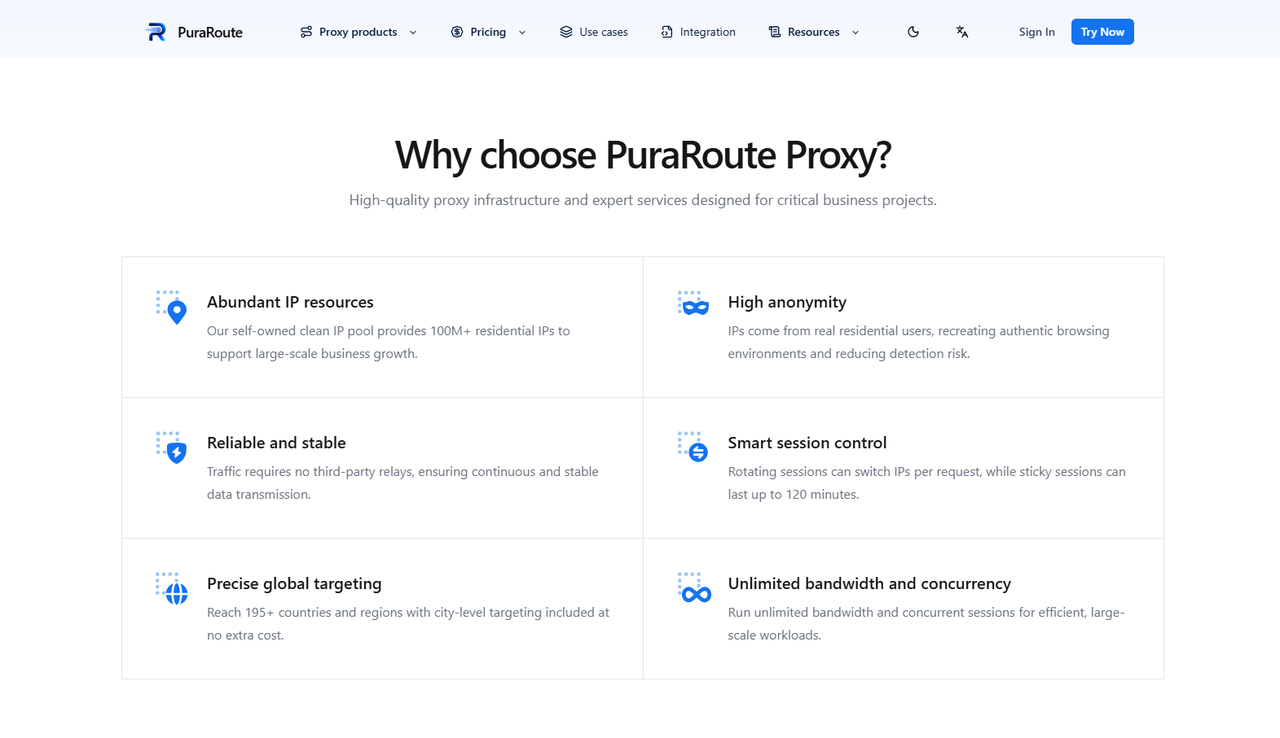
When researching international markets, users often need IP addresses from specific countries or cities. With PuraRoute's residential proxies, users can access a residential IP network covering more than 195 countries and regions, with country, state, and city targeting options. The service supports HTTP(S) and SOCKS5 connections, allowing users to configure proxies in different browsers and compatible tools. These options may be useful for checking local search results, comparing public product listings, or reviewing how websites display content in different markets. The available IP locations can vary based on current network resources.
For example, an online seller who wants to compare product prices in the United States, Germany, and Japan could select residential IPs from each market. This may help them see regional differences without searching through multiple free proxy lists. However, websites may also use cookies, account settings, and language preferences to decide what visitors see, so changing the IP address alone may not provide a complete local view.
Use Rotating and Sticky Residential Proxies for Web Scraping and Research
Different research tasks may need different IP settings. With PuraRoute's dynamic residential proxies, users can choose rotating sessions that may change the IP address between requests or sticky sessions that aim to keep the same IP for a set period. Sticky session settings support durations from 1 to 120 minutes, although the actual connection may end sooner due to network conditions. For example, someone collecting public product information from several websites might prefer rotating sessions, while a researcher checking multiple pages within one browsing session may find sticky connections more suitable. Users can select the session type based on how they collect data and how often their requests need to change IPs.
Choose Static Residential Proxies for Consistent IP Sessions
For tasks that benefit from keeping the same IP address over time, users can consider PuraRoute's static residential proxies. Unlike rotating proxies, static residential proxies provide dedicated IP addresses intended to remain the same during the purchased service period. This may be useful for managing online stores, working with business platforms, or carrying out regular checks from a consistent location. For example, an e-commerce team that needs to access a store management platform each day may prefer a fixed IP rather than changing addresses between sessions. Static residential proxies are purchased based on the number of IPs and subscription duration, with pricing and availability depending on the selected location.
Users who only need occasional access to public websites may still find free proxies sufficient. However, those handling regular research, location-based testing, or longer online sessions may benefit from comparing PuraRoute's residential proxy options. The right choice depends on the task, expected traffic, and budget, so starting with a small test can help users decide whether a paid proxy is worth the cost.
Frequently Asked Questions About the Best Free Proxies
What Are the Best Free Proxies in 2026?
Some of the best free proxies in 2026 include ProxyScrape, FreeProxyList.net, Webshare, CroxyProxy, and Hide.me. ProxyScrape and FreeProxyList.net offer public proxy lists, while CroxyProxy and Hide.me are useful for browser-based access. Webshare offers a free plan with limited proxy resources.
Are Free Proxy Servers Safe to Use?
Some free proxy servers may be suitable for basic browsing, but others can pose privacy and security risks. Unknown proxy operators may collect connection data or handle traffic in unsafe ways. Avoid entering passwords, payment details, or other sensitive information through untrusted proxies.
Can I Get Free Residential Proxies?
Free residential proxies are less common than free datacenter proxies. Some providers may offer limited trials or promotional credits, but these often come with usage limits. For regular use, paid residential proxies may offer more predictable access and location options.
What Is the Best Free SOCKS5 Proxy?
ProxyScrape is a useful option for finding free SOCKS5 proxy servers. It offers public SOCKS5 proxy lists that users can filter and download. However, connection speed, availability, and security vary between servers, so testing each proxy is important.
Can I Use Free Proxies for Web Scraping?
Yes, free proxies can work for small web scraping tests on public websites where automated access is permitted. However, unstable connections, shared IP addresses, and limited location options may lead to failed requests. For larger projects, managed residential proxies may provide more consistent performance, depending on the website and network conditions.
Conclusion
Finding the best free proxies in 2026 depends on what you need them for. Services like ProxyScrape, FreeProxyList.net, Webshare, CroxyProxy, and Hide.me offer different ways to access websites through proxy servers without paying. Some are useful for finding public IP addresses, while others make everyday browsing easier. However, free proxies often come with limits, including slow speeds, unstable connections, and potential privacy risks.
If you only need to visit a public website or test a proxy connection, a free service may be enough. But for regular web scraping, market research, or business tasks, you may need more control over IP locations and connection stability. In these cases, paid residential proxy services may be worth exploring. Before making a choice, consider your budget, how often you need proxies, and whether the service fits your specific tasks.
