
Everything you find under this term leads somewhere other than ExtraTorrent. The index that shipped its last torrent in May 2017 has not come back, and no exit address changes that. What an exit address does change is whether a block between you and a still-running site is a wall or a detour, and that distinction is worth half an hour before you pay anyone.
What an ExtraTorrent Proxy Cannot Do in 2026
A proxy rewrites where your request appears to come from. It does not host content, mirror a database, or revive an index that deleted its own records. Every page promising an extratorrent proxy without saying this is selling you a route to an address where nobody answers.
Why the Official ExtraTorrent Shut Down in 2017
The site launched in 2006 under the handle SaM and spent a decade as one of the two largest public BitTorrent indexes, behind The Pirate Bay by most counts. On 17 May 2017 it went dark without notice. Two days earlier it had shown an emergency maintenance notice, which regulars read as a hardware failure and waited out. All three of its domains resolved to the same farewell message, and the operator's only comment to press was that it was time to say goodbye. The torrent database was never released in public form.
The timing was not random. Ten months earlier KickassTorrents had lost its domains to a US seizure order and its operator had been arrested in Poland. The two closures were never formally linked, but the sequence was clear enough that the indexes still standing started trimming what they carried and where they hosted it. ExtraTorrent closed instead of relocating, and unlike several of its peers it never attempted a relaunch under another name. What survived was a name, three domains, and a search volume that has outlasted all of them.
That last detail is the one that matters here. A site that goes offline keeps a copy somewhere. A site whose index is gone has nothing for a mirror to serve.
What the Sites Ranking for ExtraTorrent Proxy Today Actually Are
Search the phrase and you get three kinds of result: expired domains someone re-registered, clones built to look like the old layout, and aggregator pages that list links to both. The best known of the clones, extratorrent.cd, was publicly identified as The Pirate Bay wearing a different skin. Its search returns TPB records because it queries TPB, not because anything of ExtraTorrent survived.
This is why the extratorrent proxy pages you find never agree on which links are real. They aren't describing the same site.
How to Tell Whether an ExtraTorrent Proxy Is a Clone
Three checks settle it, and all three take less time than reading a review.
Which Domains the Original Site Actually Used
The original operation ran on extratorrent.cc, extratorrent.one, and extra.to. That is the complete list. A different country code, an extra word, or a hyphenated variant is a third party using a name that nobody is defending anymore. Domain expiry records are public, and most of these were registered years after the shutdown.
How to Check a Torrent File Before You Open It
- Open the file list on the torrent detail page and look for .exe, .scr, or .bat where the title promised a video or an album.
- Compare the
dn=parameter in the magnet link against the page title. A mismatch means the link was assembled somewhere else. - Take the infohash and search it in a public index. If the size reported there differs from the size on the page you are looking at, the file behind the link is not the file the page describes.
The infohash is the strongest of the three, because it cannot be edited into agreement. It is a hash of the torrent's own metadata, so two listings claiming the same release and reporting different hashes are serving different files no matter what the titles say. A clone that scrapes another index will reproduce that index's hashes; one that assembles its own links will not, and the mismatch shows up as soon as you compare.
None of the three proves the site is honest. Any one of them firing means you are looking at content assembled for a different purpose than the page claims.

Why a Proxy Fixes Some Blocks and Not Others
Three failures get described as blocking, and only one of them responds to a change of address. The pages selling an extratorrent proxy almost never separate them, which is why two buyers with the same symptom end up with different results and no explanation for either.
What Each Failure Looks Like on Screen
| What you see | What is happening | Does a different exit help |
|---|---|---|
| NXDOMAIN, or a connection that times out before any response | Your resolver or your ISP dropped the lookup, or the route is filtered upstream | Yes, if the resolver is the block |
| HTTP 403, or 451 with a legal notice | The server or its CDN refuses your region on purpose | Sometimes, if the operator filters by geography |
| HTTP 200, page loads, torrent detail returns 404 or redirects to the homepage | The domain changed hands and the index behind it is empty | No |
Row two deserves its own note. Status 451 was formalized in RFC 7725 for refusals made on legal grounds, which means the operator was told to block rather than choosing to. That changes what an exit can do for you. A legal block runs through the operator's own compliance system, and where that system filters by country rather than by network, a new address in a different country can clear it. Where the block targets a whole jurisdiction, changing IP inside that jurisdiction will not.
Where a Proxy Actually Changes the Outcome
The first row is the only one where the block sits between you and a working site. Move the exit and the route changes, so the page arrives. The second row depends on whether whoever operates the site filters by region; a different country sometimes clears it, and a legal block often does not. The third row is not a network problem at all. You can route that request through a hundred addresses and the torrent detail page will still be empty, because there is nothing behind it.
Working out which row you are in takes two minutes and costs nothing. Ask the domain to resolve on your own connection first: if the lookup comes back empty, you are in the first row and the resolver is the thing to change. If it resolves and the page answers with a status, you are in the second or third, and a torrent detail page decides which of the two.
Most people who buy an extratorrent proxy expecting a fix are in the third row.
Choosing a Proxy Type for Torrent Traffic
BitTorrent does not run on one protocol. A client announces to a tracker, and that announce is either an HTTP GET carrying the infohash in the query string or a UDP datagram, depending on the tracker. Peer traffic uses the peer wire protocol over TCP, and uTP over UDP where the client prefers it. Peer discovery runs through DHT, peer exchange, and local service discovery, and none of those three touches TCP at all. An HTTP proxy only issues CONNECT and forwards TCP, so the announce can succeed while everything underneath it fails.
Why SOCKS5 Matters More Than the Country You Pick
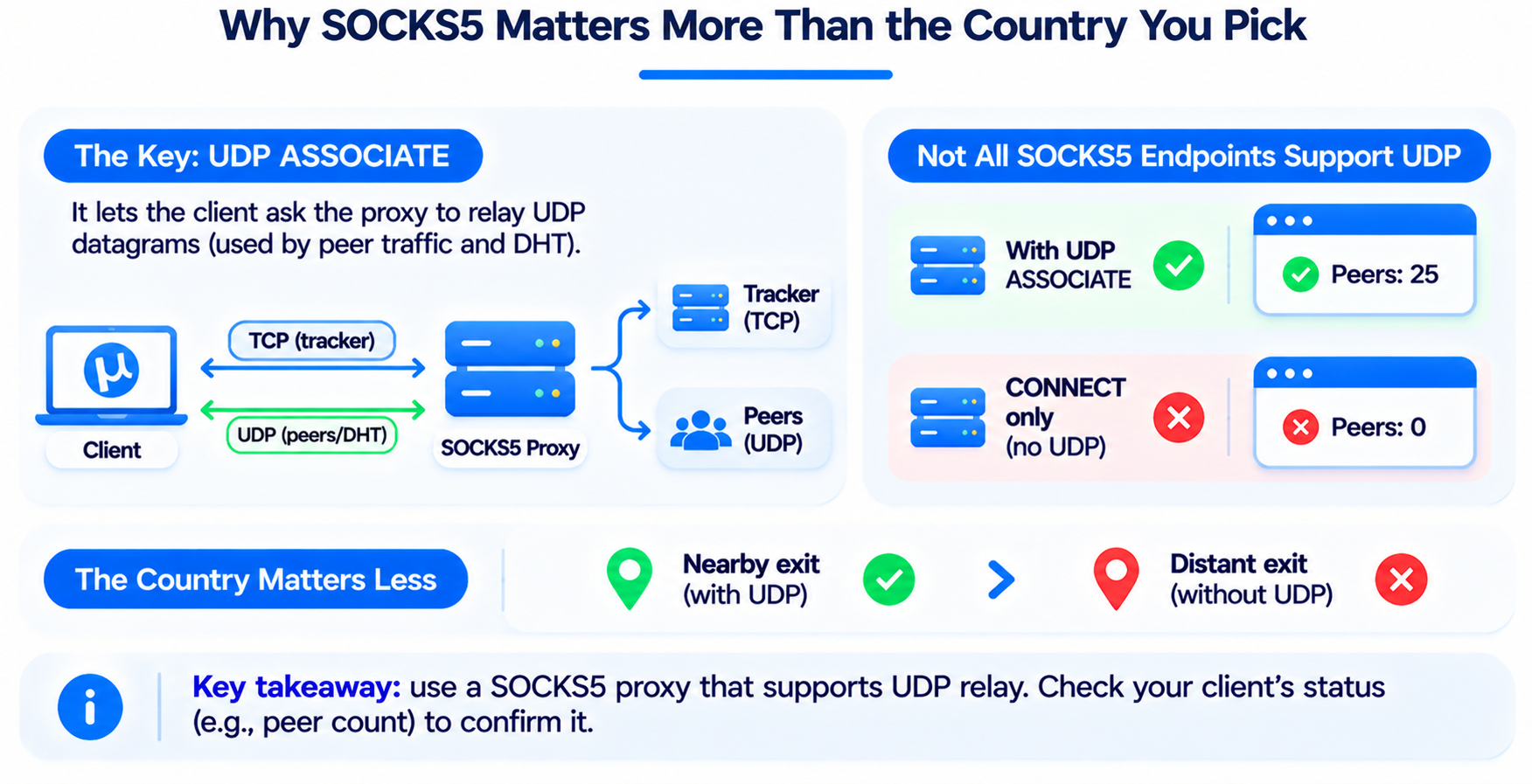
SOCKS5 is defined in RFC 1928, and the relevant part is UDP ASSOCIATE. It lets the client ask the proxy to relay datagrams, which is what peer traffic and DHT need. Support is optional in practice: a good number of commercial SOCKS5 endpoints implement CONNECT alone and drop UDP ASSOCIATE, so the handshake succeeds and the client then finds no relay for its datagrams. Without it, you get a client that reaches the tracker over TCP and reports zero peers, or one that quietly connects to peers outside the tunnel while the tracker still lists you as reachable.
The country matters less than people assume. A nearby exit with UDP relay works better than a distant one without it, and the client's own status line tells you which you have.
Static or Rotating Exits for a Download That Runs for Hours
Rotating exits break long sessions. Each change means the tracker re-registers you as a new peer, existing connections reset, and the swarm treats you as someone who left. If the swarm uses a ratio or a wait-time system, you lose that position too.
Sticky sessions help inside their window and stop helping at the edge of it. A sticky session holds the same exit while the window is open; a reconnect, a change on the provider's side, or the window expiring can all move you. Treat sticky as a convenience for short runs, not as a fixed address. When the run has to survive weeks, the answer is a dedicated address, which is a different product.
Setting Up Proxy Access in a Torrent Client
Pointing a client at an exit is a five-field job, and the settings around those fields undo it more often than the fields themselves. Two options decide whether an extratorrent proxy carries anything: whether peer connections inherit the proxy, and whether name resolution happens through it.
Where the Proxy Settings Sit in qBittorrent and Transmission
In qBittorrent, open Tools, then Options, then Connection, and find the Proxy Server block. Set Type to SOCKS5, fill Host and Port from your dashboard credentials, enter Username and Password, and enable Use proxy for peer connections plus Use proxy for hostname lookups.
In Transmission, open Edit, then Preferences, then Network, and go to the Proxy section. Set Type to SOCKS5, fill Hostname, Port, Username, and Password, then enable Use proxy for peer connections, Use proxy for tracker connections, and Use proxy for hostname lookups.
Both clients keep their listening port setting separate from the proxy block, and that separation causes most of the confusion that follows.
Setup Choices That Stop Peers From Connecting
- Sending only tracker traffic through the proxy. The client looks fine, the tracker sees you, and every peer connection leaves from your own address.
- Leaving hostname lookups on the local resolver. In a filtered network the lookup fails before the proxy is involved, and the client reports the tracker as unreachable.
- Leaving DHT, PEX, and local peer discovery enabled when the proxy does not relay UDP. They either fail silently or find peers outside the tunnel.
- Never forward the listening port. Incoming connections never arrive, the peer count stays low, and download speed collapses on swarms with few seeds.
Both clients also let you bind the session to a network interface, and that setting sits outside the proxy dialogue entirely. On a machine carrying a tunnel and a direct route at the same time, the binding decides which one handles whatever the proxy does not cover. Choose the interface deliberately instead of leaving it on any.
Alternatives to Chasing ExtraTorrent Mirrors
The public indexes that still operate are not interchangeable. They differ mainly in what they choose to carry.
How the Main Public Indexes Differ in What They Carry
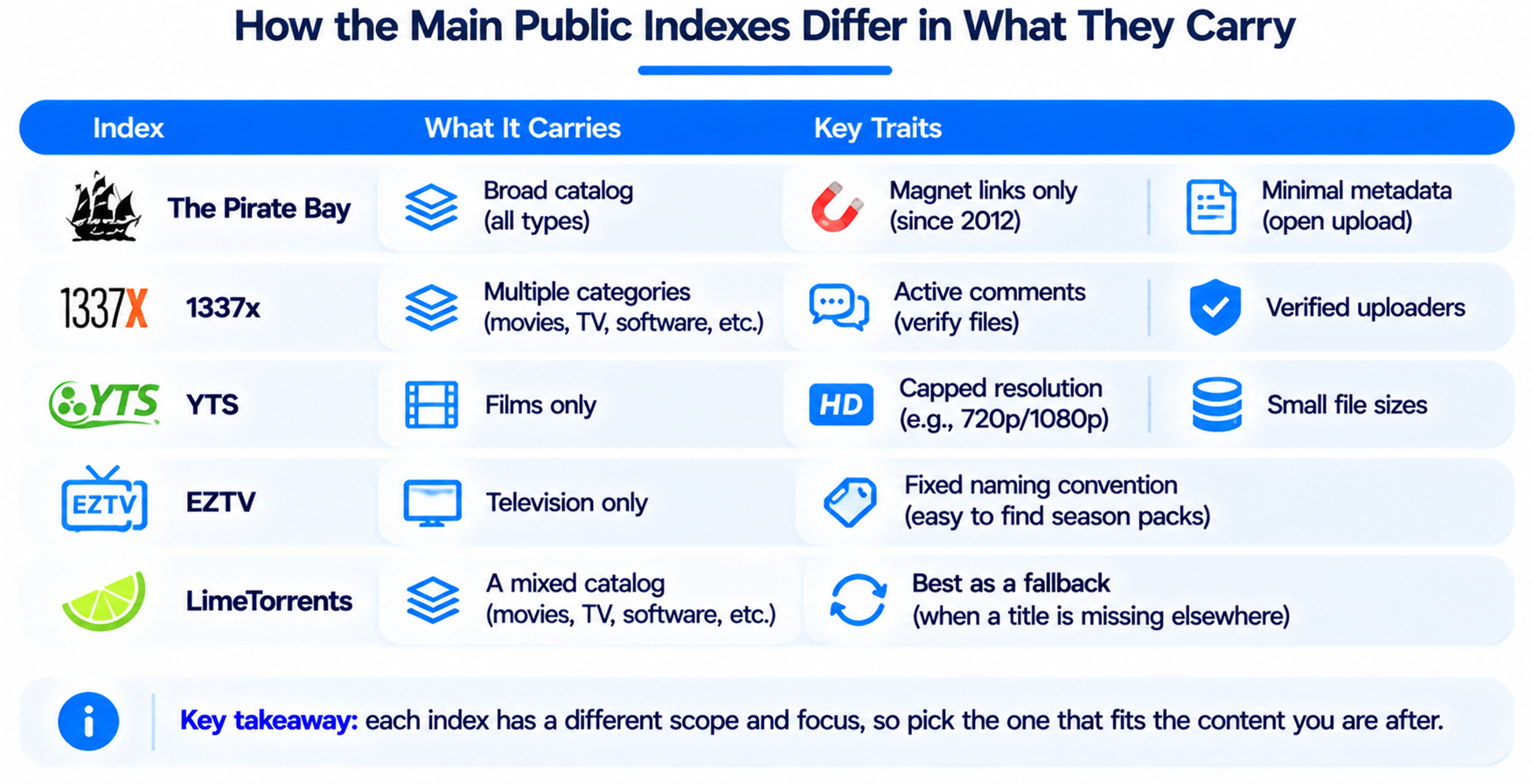
The Pirate Bay holds the broadest catalog and the weakest metadata, since anyone can upload with a one-line description. It also stopped handing out .torrent files in 2012 and publishes magnet links instead, which pushes every client toward DHT for peer discovery. 1337x organizes by category and keeps a comment thread on each listing that often tells you whether the file is what it claims, and it flags uploaders it has verified. YTS handles films only, at capped resolution and small file sizes. EZTV handles television only, with a fixed naming convention that makes season packs easy to find. LimeTorrents carries a mix and is best treated as a fallback when a title is missing elsewhere.
Which Index Fits Which Kind of Content
Films go to YTS when size matters and to 1337x when it doesn't. Television goes to EZTV. Software and games go to 1337x or TPB, where comments and uploader history are the only warning you get. Obscure material goes to TPB, because its catalog is the one most likely to hold a copy nobody else indexed.
Whatever index you land on, the reachability question is separate from the content question. A site can be perfectly alive and blocked where you are, or completely open and empty. That is the layer an exit address acts on, and it is the only layer it acts on.
Risks That Come With Clone Sites
A clone inherits the name and none of the reputation, which changes what its operators want from a visitor. Someone searching an extratorrent proxy arrives expecting to download something within a minute, and that expectation, not the catalog, is what the site is monetizing.
What a Clone Site Does After You Click the Download Button
The button rarely points at a torrent. It points at a redirect chain that ends in an installer, a browser extension, or a permission prompt for notifications. Bundled software arrives with the download you thought you wanted. In the milder version, the site requires an account before showing any magnet link, which converts a visit into an email address and a password you have now reused.
Why Clone Domains Keep Moving and Keep Getting Blocked
Blocking one domain pushes traffic to the next, and the next gets blocked in turn. A 2019 court order in Spain required local ISPs to block a batch of mirror domains, and replacements appeared within days. Each move resets whatever search history the domain had, which is why the sites ranking for a dead brand are usually registered recently and carry no track record.
Nothing about a clone still holds long enough to be worth measuring twice. The part of the connection that does hold still is on your side, and it is decided before any site is involved.
How PuraRoute Fits a Session That Lasts Weeks
Reachability is a question you ask once. Whether the connection holds is the one you keep asking, and the protocol and client settings described above only hold if the exit behind them behaves. A client left running for days keeps announcing, reconnecting, and retrying, and three things decide whether that survives: how the exit behaves over time, what you are billed for, and where the traffic is counted.
How Session Mode Decides Whether the Exit Holds
Rotating residential exits change the address between requests, which suits short and stateless work. A client left running is the other case: it re-announces on an interval, and that interval is the ruler for a sticky window. Cover it and the session keeps the same exit across several rounds. Fall short of it and every round starts over as a new peer, which is the disconnect that gets blamed on the network and isn't one. Where the address has to hold for weeks rather than hours, the honest answer is a static product, not a longer window.
Which Exit Type Fits a Download That Runs for Weeks
PuraRoute sells rotating residential exits by traffic volume, with the allowance attached to a purchase batch and its own expiry. Static residential IPs are sold by address and cycle, dedicated for the whole term, with unmetered traffic and reserved bandwidth, and the same IP on renewal. Static native and carrier native exits sit on real subscriber networks where the registered location matches the physical one.
The two billing models diverge sharply once a task runs for days. A traffic-billed pool charges for retries and failed connections, and a long session produces plenty of both, so consumption keeps climbing whether or not anything useful moves. An address billed by cycle charges nothing extra for the same retries, and the cost stays flat however many rounds the client goes through. That difference, rather than the headline rate, decides what a month of continuous use actually costs.
How Traffic Is Counted and Split Across Subaccounts
Usage on the rotating pool is billed in gigabytes, and a subaccount has to exist before that pool can be used. Each subaccount carries its own allowance, so two workloads on one account do not eat into each other's quota, and daily usage is visible per subaccount in your dashboard. That daily figure is the one worth watching on a long session. A client that stays up overnight announces, retries, and rechecks pieces on a schedule, so a day where consumption jumps without a matching change in activity is usually the first sign that something is looping.
Frequently Asked Questions About ExtraTorrent Proxy
Is the official ExtraTorrent ever coming back?
No. The index was deleted at shutdown and never released, the farewell notice described the closure as permanent, and the domains have either expired or been re-registered by third parties.
Can a proxy bring back a shut-down index?
No. A proxy changes the route a request takes. It cannot supply content that the destination no longer holds, and every clone built on the old name is serving someone else's index.
Why do so many ExtraTorrent domains still load?
Because registration is cheap and the brand still gets searched. Plenty of extratorrent proxy domains resolve and return a homepage for that reason alone, and a search box on that page tells you nothing about what sits behind it. Check the domain against the original three, then check whether a torrent detail page returns actual data.
Do you still need a proxy if you switch to another index?
Only if that index is blocked where you are. Test it from your own connection first: if the page loads and search returns results, an exit address adds nothing. If the lookup fails or the connection resets before any response, a different exit is the relevant fix. The test is the same one you would run on an extratorrent proxy page, and it takes the same two minutes.
Conclusion
Next time a page offers you an extratorrent proxy, run three questions in order. Is the domain one of the three the original site used? Does a torrent detail page return real data, or does it redirect home? If it fails on either count, no exit address will help, and the only decision left is which working index to use instead. If the site does work and your own connection is what fails, then the address is the problem, and that is a purchase you can make with a reason.
None of those checks costs anything, and they work on the extratorrent proxy pages you will find next month as well as next year. The domain list does not change, the index behind a clone is never the one it advertises, and a detail page that redirects home was never going to fill itself in.
