
A scraper that ran clean for two days starts returning 429 on the third. Nothing in the script changed. The address it was leaving from had been doing the same thing for forty hours, and the site had been counting.
The usual fix is a rotating residential proxy: a residential exit that changes address either on every request or when a time window closes. The client keeps talking to one endpoint and never sees the pool behind it. What that arrangement actually changes, where it stops helping, and which settings to touch first is what follows.
What Rotating Residential Proxies Are and Why Sites Block Requests
A block is rarely about a single request. It is about a pattern the site can measure and a history the address already carries.
The name covers two separate things. Residential says where the address comes from, a consumer ISP connection rather than a hosting provider. Rotating says how long you keep it: one request, or one window, and then a different address. Either half can exist without the other. A service can hand out residential addresses and never rotate them, and a pool that rotates hosting addresses still arrives at every checkout page with a hosting ASN attached.
Common Reasons Websites Block IP Addresses
Most blocks trace back to one of four patterns, and they tend to escalate in the same order.
- Request rate above the threshold set for that endpoint, counted per minute or per hour and answered with 429 instead of a page
- An address, or the /24 around it, that has been used for abuse before, which pushes the whole range into a lower trust tier
- Login behaviour that does not fit the environment producing it, such as a session that appears from three countries inside an hour
- A source country that does not match the account or the catalogue being requested, which marketplaces that price by region treat as a signal
Rate limiting runs per endpoint with its own threshold and window, which is why an address can browse a product page without trouble and hit a wall on the search box (rate limiting rules). The first block a collector meets is almost always this one.

How a Proxy Changes the Address a Request Appears to Come From
At the network layer a proxy rewrites the source address in the IP header, and the destination reads the exit as the origin of the connection. Nothing above that layer moves. The cookie jar, the header order, the TLS fingerprint, and the timezone reported by the browser all belong to the client that opened the connection.
That limit explains a failure people misread. If the site counts requests per session cookie rather than per address, changing the exit does nothing to the counter. The session keeps its identity and the rate keeps climbing.
What Rotation Does to the Request Rate a Single Address Sees
Rotating residential proxies divide that request count across the pool. Two hundred requests in an hour from one address is a pattern; the same two hundred spread over forty addresses is five each, which sits inside what an ordinary visitor generates.
The second effect is less obvious and matters more on long jobs. When an address gets blocked mid-run, a client without rotation has nowhere to go except the same address after a cooldown, and the retries deepen the pattern that caused the block. With rotation the next connection leaves from somewhere else, and the job continues at the cost of one failed request.
What Makes Rotating Residential Proxies Different from Other Proxies
Spreading the rate is something any pool can do. What separates one pool from another is where the addresses sit and how long you are allowed to keep one.
How Rotating Residential Proxies Compare With Static Residential Proxies
The comparison comes down to a trade the buyer makes once, at purchase.
| Rotating residential | Static residential | |
|---|---|---|
| Address across requests | Changes per request or per window | One IP for the whole term |
| Billing unit | Traffic, in GB | IP count times term |
| Session length it suits | A page, or a short sequence | Weeks of logins on one account |
| Typical misallocation | A checkout spread across three addresses | High-volume collection on a metered line |
| Renewal | Nothing to renew | Renewing on time returns the same IP |
A static address is bought the other way round: static residential IPs are billed per IP for a fixed term, with no traffic cap, which suits an account that has to look like the same person for a month. The wider choice between the two models has its own write-up if the boundary is still unclear: static vs rotating proxies.
How Residential Exits Compare With Datacenter Exits
Send the same request from a hosting range and from a subscriber line, and the destination reads the difference from the address itself. A datacenter address belongs to a hosting provider's ASN, and its reverse lookup usually resolves to a cloud region. A residential address belongs to a consumer ISP and resolves to a subscriber line.
Neither type changes the header set. What differs is the history attached to the address and what a risk score does with the ASN. A hosting range arriving at a checkout is unusual and gets weighted for it; the same range arriving at an API endpoint is unremarkable, because that is where hosting addresses normally come from. Datacenter capacity is faster and costs less per unit, which is the honest reason it stays popular against targets that do not score ASNs.
Above both sits mobile, where the addresses belong to phones rather than homes. There is less of it and it costs more, so it earns a place only against targets that treat carrier ranges differently from wired ones.
The residential half is what most people mean by the phrase, and residential proxy exits come from consumer ISPs in 195+ countries, targetable down to a city.
What Residential IP Rotation Gains Over a Single Fixed Address
A run no longer depends on one address surviving, which takes the single point of failure out of a job that takes hours. The same collector can compare one page across markets without buying separate hardware. And a failed request can go out from somewhere else immediately instead of waiting for an address that is already suspect to cool down.
How Do Rotating Residential Proxies Work
The differences above are about the supply. What happens between a client and that supply is a shorter story than the sales pages suggest: one endpoint in front, a pool behind it, and a rule that decides which exit carries the next connection.
The Process of IP Rotation Explained
The client authenticates to a gateway with a username and password, and the gateway picks an exit from the pool. Everything after that is an ordinary proxied request. On plain HTTP the gateway sees the full request line, including the absolute URL. On HTTPS it sees the CONNECT target and, in most configurations, the SNI field naming the host.
A new exit gets assigned when one of these happens:
- The next request arrives under a per-request rule
- The session window expires
- The client drops the connection and reconnects
- The gateway retires a node that failed its health check
Nothing in the client decides which address it gets. That is the part buyers expect to control and cannot, and it is why the same script behaves differently against two providers with an identical pool size.

What Session Persistence Does for a Login Sequence
A sticky window keeps one exit for a defined period. Requests inside the window leave from the same address, so the platform sees one visitor working through a sequence rather than several visitors taking turns.
Where it matters is anything with state on the server: a cart, a quote, a multi-step form, pagination behind a session token. Send page four from a different address than page three and the platform has a choice between treating it as a hijacked session and starting over. How the window is set differs by provider; some expose a timer in the dashboard, others encode it in the session string.
How Backend Rotation Keeps a Session Running Without a Fixed Address
Rotation happens on the provider's side, which is why the client never maintains a list of addresses. The gateway tracks which nodes are healthy and routes around the ones that are not. When an exit fails mid-request, what the client usually sees is a timeout rather than an error message, because the failure happens after the connection was accepted.
One consequence is worth planning for. The pool is shared and the choice is not yours, so a retry can land on the address that just failed. Two retries with a pause between them behave differently from two sent back to back.
Risks to Avoid When Using Rotating Residential Proxies
Everything that goes wrong with rotation traces back to one of three places: the pool, the window, or the choice made before either.
Why Low-Quality Proxy Pools Harm Long-Running Jobs
The pool behind rotating residential proxies is shared by definition, and an exit that many customers draw from carries their history along with your request. If someone else used that address for credential stuffing last week, the risk score arrives with you and no configuration change removes it.
The symptom is rarely a clean block. It shows up as a rising timeout rate, verification pages on URLs that used to load, and requests that succeed on a retry from a different address. A cheap pool is not slow so much as inconsistent, and inconsistency is what breaks a job running unattended.
How the Wrong Rotation Interval Gets a Session Flagged
Rotate too fast and a login sequence spans five addresses in two minutes, which reads as an account being passed around. Rotate too slowly and one address accumulates the volume rotation was meant to spread, which puts you back at the first block with extra steps.
The setting that fits is decided by what the target remembers between requests. A public product page remembers nothing, so per-request rotation is fine. A page behind a session token remembers everything, so the window has to outlast the sequence.
Common Mistakes When Choosing a Proxy Provider
- Comparing pool sizes from marketing pages, where the number counts addresses ever seen rather than what is available now
- Ignoring the billing unit until the invoice arrives, then finding that blocked requests were billed as traffic
- Buying country-level targeting and discovering the task needed a city
- Assuming rotation is on by default, then finding a single sticky address a week into debugging
How to Choose the Right Rotating Residential Proxy Provider
Most of the risks above are decided at purchase. The shortlist for rotating residential proxies is shorter than the feature lists suggest, and most of it turns on the target rather than the provider.
Which Features Matter for Collection, Price Comparison and Account Work
Collection work is mostly about control: a rotation rule it can set per request, and enough parallel connections to finish inside the window it cares about. Price comparison turns on the city rather than the country, since a retailer prices by metro. Account work wants neither; it wants a window long enough to cover a login and a few clicks, which lands on a different product.
That last split is the one buyers get wrong most often: rotation bought for account work, then fought with longer and longer windows until the login finally fits. It is an expensive route to the static product, and dynamic vs static residential draws the line where it actually falls.
How to Read IP Pool Size and Geographic Coverage Claims
A pool figure on a sales page is a total the network has seen, not a count of addresses you can hold at 3 a.m. on a Sunday. The number that matters is whether the country, state, and city you need show stock when you buy, and whether the provider lets you select at that level at all.
Coverage claims work the same way. A statement of 195+ countries describes the reach of a network, not a promise that a given city has addresses on a given day. Ask what level of targeting is offered and check inventory before committing to a volume.
What to Check in Bandwidth and Billing Plans
Four things decide the real cost, and none of them is the headline rate. Whether billing runs per GB of traffic or per IP for a term. Whether unused traffic expires, and after how long. Whether blocked requests count against the quota. What happens when a plan runs out mid-job, since a hard stop costs more than an overage.
The per-GB model suits work whose volume is unknown in advance, which is most collection work. A fixed IP count suits anything with a predictable session. The two do not convert into each other, so the choice has to be made against the task rather than the budget line.
How to Set Up and Use Rotating Residential Proxies Effectively
Choosing settles what you buy. Setup is where the settings become real, and it is five steps on a laptop plus one architectural decision after that.
Step-by-Step Configuration on a Local Machine
- Create the connection in the provider's console, choosing the region, the session mode, and the protocol
- Copy the endpoint, port, username, and password it generates
- Enter them in the client, over HTTP(S) or SOCKS5; SOCKS5 forwards bytes without parsing them as HTTP, so session behaviour and proxy settings are not the same thing (SOCKS5 protocol definition)
- Load a page that echoes request headers and confirm the address shown is the exit, not your own
- Run the same check twice with rotation on and confirm the address changes
Step four is the one people skip. A proxy that accepts credentials and returns pages can still be leaking the original address through a header, and the echo page is the only place that shows it.
How to Wire a Proxy Into a Scraping Stack
Most libraries take a proxy dictionary or a launch argument, and the differences between them matter less than the retry logic around them. Separate the two failure types. A 429 is a rate decision and wants a different address. A timeout may be the node and wants a retry after a pause. Treating both as "try again" produces a loop that looks busy and collects nothing.
Concurrency deserves its own number. Twenty workers on rotating residential proxies is not twenty times faster if the target limits per session cookie, and pushing past that point only shortens the life of the addresses you hold.
How to Tune Session Persistence Against Rotation Frequency
Measure the sequence, not the clock. If a task needs six pages to complete one record, the window has to cover six pages at whatever pace the target serves them, plus a margin for one slow response. Setting a window by feel is how a job that works at noon fails at midnight when the target slows down.
Inside a window, do not reconnect. A new connection is a chance to land on a different exit, and on some providers it is a certainty. On longer tasks the opposite applies: rebuilding the connection on a schedule is cheaper than waiting for a session to go stale.
When Should You Use Rotating Residential Proxies
Reading a price table and working through a checkout use the same request method and are completely different jobs. What separates them is whether anything on the far side is keeping track.
Where Rotating Residential Proxies Fit in Web Scraping
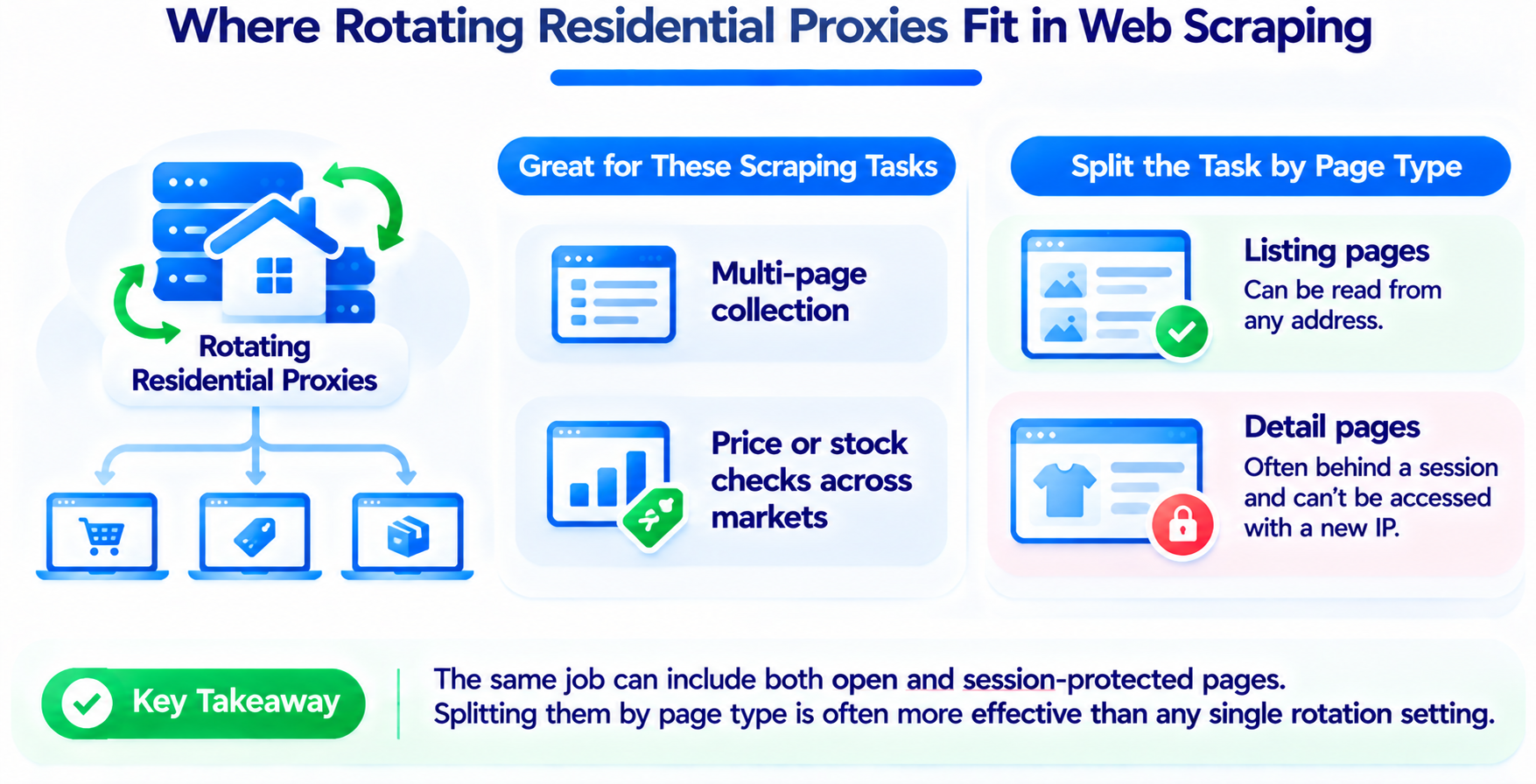
Multi-page collection is the obvious case, and so is a price or stock check run across several markets, because each record stands on its own. The same job often holds both kinds of page: a listing that can be read from any address, and a detail page behind a session that cannot. Splitting the task by page type is worth more than any single rotation setting.
How SEO Tracking and Ad Verification Depend on Local Exits
Search results are assembled per market, sometimes per city, and an agency checking a campaign has to see what a shopper there sees. What both need is accuracy of location rather than speed of rotation. A checker that rotates between requests across a whole country tells you less than one that holds a city for the length of a check.
Why Account Management Rarely Fits a Rotating Proxy Setup
A login is the clearest case against rotation. The platform compares an address against the history it holds for that account, and a run of addresses inside one session reads as a change of device or a shared credential. Account work belongs on a fixed address held for weeks, which is the static product, or on a sticky window long enough that rotation stops happening in practice.
Are Rotating Residential Proxies Legal in 2026
None of these uses is unlawful in itself, which is both the point and the limit of the answer.
Understanding the Legal Use of Proxies
Operating a proxy is lawful in most jurisdictions, and using one is lawful in most of the rest. A proxy does not launder copyright infringement, fraud, or unauthorised access. In several countries a court order blocking a service also covers reaching it through a proxy, so the technical route does not change the legal position. Terms of service are separate from law, and a site can refuse proxied traffic without any legal question arising.
Ethical Considerations Around Residential IPs
Residential addresses come from devices belonging to real people, and how a network obtains them is worth asking before buying. A pool built with informed consent and compensation is a different product from a list assembled by scanning for open devices. Free lists sit at the far end of that range: nobody can tell you where the addresses came from, and the operator's incentive is not yours.
What PuraRoute Controls Inside a Rotating Residential Proxy Setup
A rotation rule is a line of configuration. What it draws from is a supply of addresses, each with an owner, a location, and a history, and the settings only mean something against that supply.
Suppliers rent that supply out by traffic rather than by connection, with the session behaviour decided at the moment a connection is generated. The dynamic residential line at PuraRoute is one such supply, and both that decision and the exit location are settled before a connection is handed over.
How Rotation Windows and Sticky Sessions Are Configured
Two session modes cover the split described earlier. Rotating changes the exit between requests, which is what a listing scrape needs. Sticky holds one exit for a window, and connections generated through the Open API accept a window from 1 to 120 minutes, outside which the session is no longer guaranteed.
Because the choice is made per connection, one account can run both: a listing job on rotating and a detail pass on sticky, from the same credential set.
How Country, State and City Targeting Narrow the Exit Pool
Region selection goes three levels deep, from country to state or province to city, and a connection without a region is assigned from whatever the network has available. The public coverage figure is 195+ countries. Whether a specific city holds stock is visible in the console before the order is placed.
ASN targeting also appears on the product page for this line. Whether every ASN is selectable depends on what the console offers at purchase, so treat it as a filter to check rather than a guaranteed control.
Frequently Asked Questions About Rotating Residential Proxies
Can Websites Detect Rotating Residential Proxies
Yes, and the address is usually not what gives it away. A detection stack reads the TLS fingerprint, the header order, and the rhythm of requests, none of which rotation changes. A residential exit lowers how suspicious the address looks. It does not make the client behind it look like a browser.
How Often Should a Rotating Residential Proxy Change IPs
As often as the target's memory allows. Public pages that hold no session state can take a new address per request. Anything behind a token, a cart, or a login needs a window covering the whole sequence, which is usually minutes rather than seconds.
Are Rotating Residential Proxies Suitable for Small Jobs
They are, and the billing model is the reason. Paying by traffic means a small job costs a small amount, with no minimum IP commitment. The caveat is pool quality: on a shared network, a small buyer has no say in who else used the address today.
How Free and Paid Rotating Residential Proxies Differ
Free lists are shared with everyone reading the same page, come with no session control, and offer no account of where the addresses originated. Paid service buys what a list cannot provide: an origin you can ask about, a console that sets the session mode, and someone to reach when a range goes down.
Can Rotating Residential Proxies Be Used for Mobile Apps
If the app sends HTTP or HTTPS, it can be pointed at a proxy the way a browser is. Apps with their own transport, or with certificate pinning, ignore the system proxy and need their own settings, which many do not expose. Check what the app actually speaks before buying anything.
Conclusion
The first question is whether your target remembers anything between two requests. If it does not, rotation per request is the cheap answer and a longer window only slows the job down. If it does, the window has to cover the sequence, and an address that changes mid-sequence costs more than the traffic it saves.
Getting that order backwards is common. Buyers pick a pool size first, discover the task needed a city, then extend the sticky window until the product they bought is a worse version of the one they should have bought. The target's memory decides the settings. The pool only decides how well those settings hold up.
