

Scamalytics has a memorable design: an input box, a scale running from low to high risk, and a Fraud Score. Compared with websites that require some understanding of network terminology before you can use them, it goes straight to the conclusion that is easiest to share: whether this IP is risky.
That simplicity has value for people who want to quickly eliminate resources with obvious warning signs. The problem is that buying a proxy involves location, network type, usage history and connection quality. A fraud score cannot answer all those questions. Something else is easier to overlook: the score may not always be based on direct observations of the address itself.
I would use Scamalytics as a risk-screening tool: it is good at drawing attention to suspicious signals, and its explanatory paragraphs are worth reading; but if you keep only a screenshot of a score of 0, you may crop out the most valuable evidence. Here is a closer look at its public website, individual fields and the trade-offs involved in using it at scale.
Starting with the free report: what does it take to read the whole result?
Open the Scamalytics IP lookup, and the input box appears at the top, followed by the risk bar and explanation. Network organization, location, datacenter information, external lists and proxy types appear below. The reading path for a query is shorter than on a large network intelligence site, making it convenient for obtaining a quick summary.
On October 21, 2026, I viewed the report for the public address 8.8.8.8 and saved a screenshot. This is a public infrastructure address, used here to illustrate the interface and the explanation of the score. It is not a test sample of a commercial residential proxy.
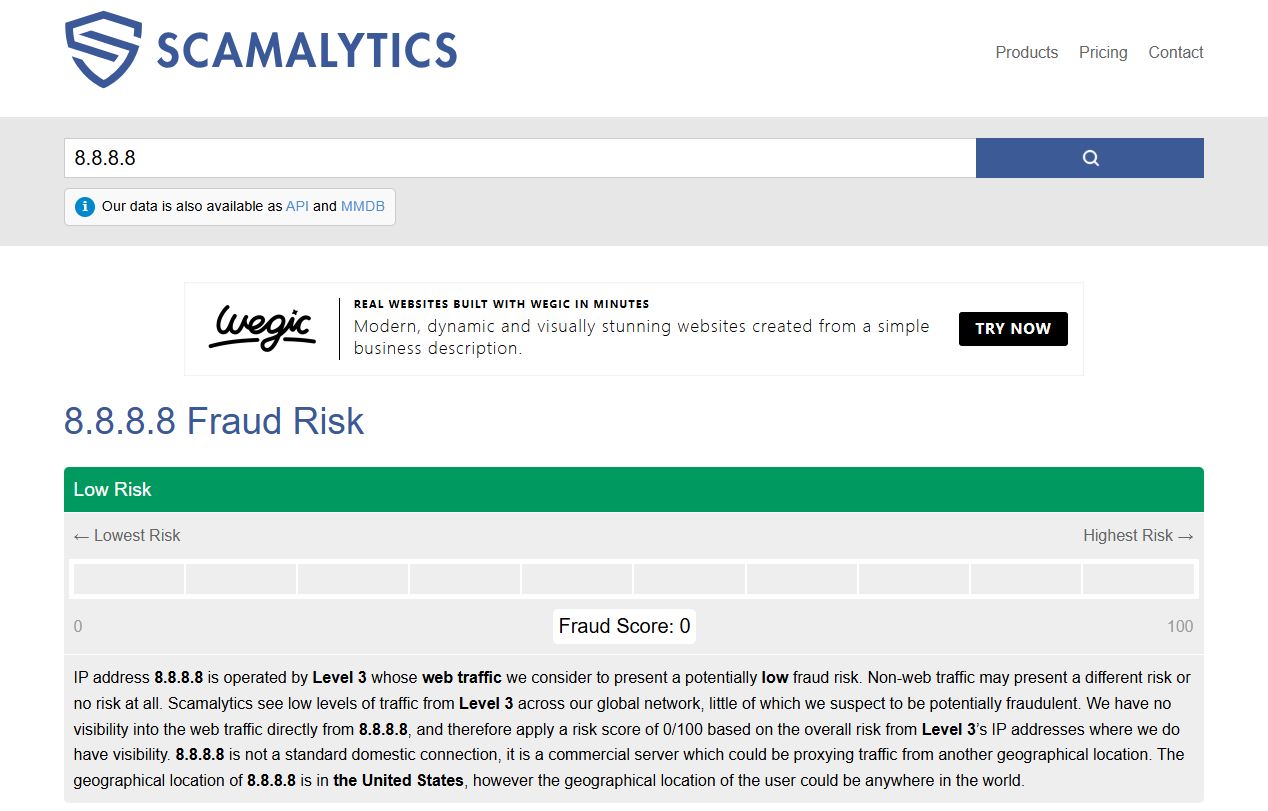
Figure: Page observation on October 21, 2026. Public reports can change; the screenshot does not represent the risk of a resource being purchased today.
For a first lookup, I suggest reading in three places:
- At the top: read the overall risk alert.
- Below the score: check the reasoning and whether enough data is available.
- In the details: examine specific types and list findings.
That path is a strength: scan first, then investigate. Capturing only the top or collecting a few No results below misses the explanation in between.
There is also a promotional area between the query interface and the results. It does not change what the fields mean, but when processing many addresses, distinguishing ads from the report, scrolling through a long page and saving results manually all add work. The site is well suited to occasional queries. Its convenience as an everyday workspace for batch checking needs a separate assessment.
The most useful question about a score of 0 is what it is based on
The public report for 8.8.8.8 shows a Fraud Score of 0 and low risk. Its explanation also says that it has not directly observed web traffic from this address and is using overall risk information for the associated network. Google LLC and Level 3 also appear in separate organization fields on the page.
The point that changes my assessment is this: the zero looks definite, but information about the individual address is limited. Scamalytics deserves credit for saying so. The problem is that the number stands out much more than the explanation. Readers can easily mistake “no problem seen” for “thoroughly checked and confirmed clear.”
Think of a network as a neighborhood: knowing the neighborhood's general circumstances is different from having inspected every address in it. This kind of background inference can provide clues when data is scarce, but it should not be rewritten as “nothing has ever gone wrong at this particular home.”
Why should the difference between Google and Level 3 not be skipped?
Different organization fields in a report may describe different roles, or reflect different sources and update histories. If the names differ, investigate the network attribution rather than automatically choosing the most familiar name. Comparing what the ASN, ISP and Organization fields each refer to is more useful than declaring that one name must be correct.
This also illustrates the distinction between a risk tool and a network attribution tool. Scamalytics primarily produces a risk summary, with organization information providing context. To investigate where a resource actually comes from, you can supplement it with IPinfo or registration and routing records. A low score does not mean that every background field has also been independently verified.
I find the report easy to scan, but less helpful for readers in a hurry. A large score speeds up the lookup; placing the important condition in ordinary body text makes it easy to lose in screenshots and shares. Giving the limited-data notice similar prominence would help readers make a better decision.
How should Fraud Score, datacenter status and residential proxy detection be read together?
Putting risk and connection type on one page makes Scamalytics more useful than a score alone. They do not, however, form a sequence of checks that must all be passed before a resource can be used. First distinguish three questions: what network the resource belongs to, whether it has been observed as a proxy, and what risk signals exist.
| Information | Main purpose | Common misinterpretation |
|---|---|---|
| Fraud Score / Risk | Read the site's overall risk assessment | Treating the score as an account-ban probability or an overall quality rating |
| Datacenter / Server | Understand the server or hosting background | Treating hosting use as proof that fraud has occurred |
| VPN, Tor, Public Proxy, etc. | Identify particular anonymization or proxy characteristics | Assuming that no match means no platform can identify the proxy |
| Residential Proxy | See whether a residential proxy network has been identified | Mistaking residential proxy detection for evidence that the address is not residential |
| External Blacklists | Find negative signals from external sources | Treating several No results as comprehensive safety certifications from several organizations |
A datacenter address can have a low score, and a residential address a high one
Network type describes the resource's attributes; risk involves its usage background and what has been observed. A server that has operated normally for a long time may have no obvious risk records. A residential exit IP may have been used for substantial anomalous activity. The two dimensions do not have to rise and fall together.
When buying a residential resource, first verify the type against the seller's promises, then use Scamalytics to investigate its reputation. When buying a server proxy, an expected hosting label may be acceptable; the priority is risk relevant to the task. A very low number cannot replace product requirements, and identifying a proxy does not automatically establish that the supplier failed to deliver the service.
Teams using proxies lawfully may still be identified as using proxies. Purchasing goals should therefore specify clear resource and usage requirements, rather than require “every check on every website to say not found.” The latter is difficult to verify and often mixes unrelated fields together.
When scores of 9 and 53 appear together, which one should you compare?
When a report contains two scores, do not simply choose the lower one. The Premium API example lists Scamalytics’ score of 9 alongside an external residential-proxy score of 53, with residential proxy detection set to true. This is the provider’s format example, not a test performed for this article. It illustrates a practical reading difficulty: one response can contain scores from different sources.
It helps explain a common issue: scores within the same aggregated response may belong to different data sources and evaluate different things. You cannot simply use 53 to disprove 9, or average them and call the result a “true IP reputation score.” A meaningful comparison first requires knowing who is scoring, what is being scored and the relevant time.
Keeping sources separate is one reason I would recommend it for further investigation. You can see where a difference comes from before deciding which item to examine. The tradeoff is that each score needs its own explanation. They do not belong in one ranking and should not simply be averaged.
With so many external blacklists, why might cross-checks still lack independence?
The public report lists names such as FireHOL, IP2ProxyLite, IPsum and Spamhaus, creating an impression of multiple checks. These sources can indeed uncover additional clues, but first examine what each one covers.
Some lists focus on proxies, others on particular kinds of malicious infrastructure or aggregated risk. They differ in what they observe, how frequently they update and how long they retain records. A No may mean that a particular check returned no match. It does not mean that every security organization has confirmed the address is risk-free.
Aggregators and external lookup sites may also use the same underlying sources. Seeing an IP2Proxy finding on Scamalytics and then obtaining the same finding from another site that uses IP2Proxy does not automatically give you two independent measurements. For readers, recognizing a repeated source matters more than collecting additional votes for the same conclusion.
Useful cross-checks add evidence about different aspects of the problem
If the concern is web fraud risk, consider Scamalytics' assessment. If there are signs of recent scanning or brute-force attacks, examine the specific incident reports. If the location conflicts with the order, investigate geolocation and network attribution. If access fails, check the connection path and destination service.
These steps address different questions. By contrast, placing three websites that cite the same underlying data side by side shows agreement in presentation, rather than proving more complete coverage.
I would also avoid deciding whether to replace a proxy mechanically by counting the lists it appears on. One recent, clearly documented incident relevant to the actual fault may deserve more attention than several old or unexplained list entries. Scamalytics is a starting point for investigation; the appropriate action depends on why a match occurred.
Residential proxy detection matters, but it does not establish an absence of false positives
Residential proxy networks are harder to distinguish from organization information alone than traditional hosted proxies. Genuine residential connections can also act as relay nodes. Address rotation, relationships between suppliers' resources and differences in observation scope can further affect identification.
In their residential proxy measurement study at WTMC 2023, Chiapponi, Dacier and Thonnard compared the ecosystems and network behavior of four services and discussed methods of identification at the address-block level. The study did not rank Scamalytics. It does, however, show why residential network background and proxy use must be investigated separately, and why an ISP name alone is not enough for identification.
For this website, the useful question is not whether it has a residential proxy label. It is whether sources, timing, unknown states and scope are clearly identified. A new exit IP may not yet have been observed, and a historical label may lag behind current circumstances. Both missed detections and false positives require verifiable samples. One positive or negative screenshot cannot establish overall accuracy.
I would recommend it because there are reasons to investigate beneath the score, not because it has been proved more accurate than its competitors. To judge its usefulness for your work, track what happened to high-scoring addresses, whether low-scoring ones stayed usable, and whether the checks saved you unnecessary effort.
Useful for web-access risk; other problems need other tools
Scamalytics explains in public reports that its perspective concerns web traffic from users connecting to websites and applications. It does not cover the entire internet or amount to a complete observation of server-to-server communication. This limitation should be retained carefully because it directly determines where a low-risk result can be applied.
If you are concerned about SSH brute-force attacks against a server or other security incidents, a web fraud score alone may omit relevant information. If your concern is the risk of users accessing an application, that observational perspective is closer to the question. No scope is inherently superior in every setting; what matters is whether it fits the need.
Nor is it a complete browser leak test. Looking up IP intelligence does not automatically check whether DNS bypasses the proxy, whether WebRTC exposes an unexpected public network path, or whether other applications inherit the configuration. The public page can explain an address's background. How a browser actually connects requires the corresponding tests.
I see this as a clear tool focus rather than a lack of functionality. Its scope becomes exaggerated only when it is presented as one score that solves every IP problem. Understanding that division helps identify which tasks it saves time on and which still require other tools.
From individual queries to batch screening: upgrading is about field access as well as volume
For a few IPs each week, opening the webpage is convenient enough. Screenshots, records and comparisons become a burden at larger volumes. That is when an API—an interface for programmatic queries—or Bulk Lookup is worth considering. Define which work needs automation before upgrading, rather than add maintenance merely to appear more professional.
The current API and batch lookup information offers a free starting allowance, with more advanced data available as add-ons. Billable request volume, basic results, external data and detailed residential proxy intelligence need to be considered separately. A free API allowance does not imply that a free response includes all the information mentioned on the public website.
A placeholder, null and false are three different states
The easiest mistake in batch checks is turning “no result obtained” into “no risk.” The v3 API can include a field but fill it with an upgrade message or null—an empty value—when the account lacks access. A person may notice; a program may count the blank as a pass. That makes a whole batch look more reliable than it is.
Suppose you want to filter out residential proxy networks, but your current access level does not include detailed data. A field without an actual value can only mean unknown; it cannot prove that the address is not a residential proxy. Check the response status and which fields are available before making a decision.
There is another inconvenience when integrating it: different tables do not fully agree about access to some residential-proxy fields. Before using them for automatic screening, I would confirm what my account actually receives and clarify the access level with the provider. Otherwise, it becomes hard to tell whether an address was not detected or the check was never available.
Trial results should not automatically be treated as representative of a long-term basic plan
More information during a trial and less on the basic plan can simply reflect changed access. Trials may include advanced add-ons, so they do not establish what the basic plan supplies long term. I would match each required result to the plan that includes it, rather than discover after the trial that a key field has disappeared.
For batch users, the useful practice is to retain the query time, actual exit IP, response status and subscription version. You need to know what each query returned before discussing whether a score change is meaningful. I did not activate a paid service for this review and do not use the documentation to assess live API latency or continuous availability.
How can the report support proxy selection and discussions with a supplier?
I suggest checking location and resource type before reading Scamalytics. That helps avoid overlooking a resource that does not match the order merely because it scores 0, or dismissing a legitimate use merely because a proxy label appears.
If there is an obvious risk signal, retain the specific finding and explanation rather than taking a screenshot of the risk bar alone. If nothing unusual appears, continue by checking connectivity to the intended service and stability. There is little reason to spend more time chasing a lower number.
When discussing a report with a supplier, bring a record that can be checked: the order, current exit, lookup link, time, and the task affected. PuraRoute’s detection-discrepancy process uses these details to distinguish label disputes from connection faults. That helps investigate the issue and shows whether support is addressing it, rather than simply telling you to use another checker.
The point is an actionable support process. A risk site cannot explain a supplier's delivery on its behalf, and a supplier should not use another attractive screenshot to dismiss existing concerns. Ultimately, the promise, resource and actual circumstances still need to be checked. Whether a replacement, refund or another remedy applies depends on the relevant terms.
How would I handle three common situations?
The following are hypothetical applications of the method, not proxy test results from this review.
Low score, the expected resource type and stable service. Keep the resource and record the initial result. There is no need to replace it repeatedly because other sites show minor differences. Further checks become necessary when a new anomaly appears.
Low score, but a clear mismatch with residential or location requirements. Address the delivery discrepancy first. Low risk only means there is no obvious warning on that dimension; it cannot supply missing resource attributes.
High score, accompanied by credible recent incidents and persistent access problems. Investigate it as a priority. The score, incidents and business experience now complement one another, giving more reason to investigate than an isolated label would. Still check account issues, request settings and destination service outages separately as possible contributing factors.
This approach fits everyday work better than a universal rule that any score above a certain number makes a resource unusable. A threshold can help assign investigation priority without replacing every other judgment.
If a team plans to rely on it long term, how can it tell whether screening helps?
For occasional lookups, understanding the conditions is enough to obtain value. Once a team plans to use a single score to decide which resources to retain and which to return, it needs to validate that rule for its own tasks. This is also an important part of how I judge whether a risk tool is worth a long-term investment.
First, record resource facts separately from business outcomes. Resource facts include supplier promises, the actual exit IP, network type and query time. Business outcomes include whether connections succeed, whether timeouts persist and whether explicit errors appear. Do not use a high score from another detection site as ground truth. That merely makes two models act as judges of each other.
Second, retain both no-match results and unknowns. Only when the API has explicitly completed a check and returned an actual value should it enter the corresponding statistics. Failed queries, restricted fields and insufficient data should each be recorded separately. Combining every unknown with low risk can make early results look impressive when, in fact, some addresses were simply checked less thoroughly.
Third, do not interpret CAPTCHA frequency directly as fraud detection accuracy. CAPTCHAs may be affected by the browser, account, request rate or destination service. They can be recorded as part of the business experience, but are not labels proving that an IP is malicious. Differences in how the same address behaves in different environments cannot all be attributed to the risk database either.
What information does a useful record need?
I would save the actual address and query time, Scamalytics' own score, specific types, external matches, and any missing-data or permission states, alongside the business conditions at the time. For automated screening, I would also record the API version and subscription coverage. After a period of use, that makes it possible to ask which high-scoring resources really needed priority attention and which results repeatedly prompted pointless replacements.
For an ordinary buyer, this does not need to become a complicated project. A spreadsheet with clearly defined fields is already easier to compare than dozens of screenshots in a photo library. Scamalytics' structured output has practical value here: you can retain the basis for screening rather than merely remember that there was once a red number.
I would assess the benefits in terms of fewer obvious anomalies being overlooked and shorter investigations. I would not begin by promising a particular reduction in CAPTCHAs or increase in account success rates. Those claims require genuinely comparable long-term evidence. This approach may look slower, but it helps avoid repeatedly buying new resources in pursuit of lower scores and still being unable to identify which replacement solved the problem.
My final assessment of Scamalytics: a useful risk summary whose conditions matter
Its clear strengths are direct queries, an easy-to-read score, and specific types and external sources that support further investigation. For users who do not want to learn an entire network intelligence system at the outset, it does lower the barrier to initial screening.
My main reservations are the gap between the prominent score and the less prominent explanation, and the impression of multiple independent confirmations created by aggregated data. The site supplies many qualifications, but cannot ensure that users notice them when reading or taking screenshots. In the API, permissions and unknown states add further interpretation costs.
Compared with IPQS, Scamalytics' public report is better suited to reading a quick summary, while IPQS' configurable risk assessment is better suited to teams that need to investigate parameters. Unlike AbuseIPDB, it does not primarily present individual community incident reports. Compared with IPinfo, its risk communication is more direct, while network investigation is a different area of strength.
My recommendation has a clear scope: use it for a concise first round of risk screening; read further into sources and conditions when you need to explain high risk; and add other evidence when you need to verify residential status, browser behavior or business stability. Saving the evidence with the score is what lets you make use of the site, rather than simply obtain an image that is easy to share.
FAQ about Scamalytics
Is Scamalytics' Fraud Score the probability of an account ban?
No. It is the site's risk assessment, not the probability that an account on any given platform will be restricted. There is no universal conversion between the two.
Does a score of 0 prove that an address has never been abused?
No. You need to examine the observation scope and the basis of the score. The public example in this review explicitly states that direct web traffic observations for the address are lacking.
Does Residential Proxy=true mean that the resource I bought is not residential?
No. An address can belong to a residential network and also be used in a residential proxy network. Check the resource definition, proxy use and task requirements separately.
Can I be completely reassured if several external blacklists all show No?
They only mean that the corresponding checks returned no match. They are not a joint certification by every security and business platform. Coverage and update times also matter.
Why can Scamalytics' score differ so much from another detection site's?
Models, sources, observation scope and query conditions can differ. First confirm that the address is the same, then compare specific signals rather than directly comparing the numbers.
Can a risk field missing from the free API response be treated as false?
You should not make that assumption. Insufficient permissions, null, placeholders and an actual false are different states. Interpret them using the documentation and the account's response.
Do I need to buy API access to check a few proxies occasionally?
Usually not. Consider permissions, usage and maintenance costs when you have a need for batch records, automated monitoring or specific fields.
