
Choosing between a visual scraper and a code-based tool gets harder when your test page works but the full job fails. The best web scraping tools need to fit the pages you collect, the fields you need, and the people who will maintain the workflow.
A clean demo tells you little about missing fields, changing page layouts, or failed requests. A tool that extracts one product page may still need extra setup for pagination, JavaScript content, and repeat runs.
Start with the job rather than the feature list. Compare no-code web scraping tools and Python web scraping tools against the same sample pages. Check how each handles navigation, exports, scheduling, and errors. Keep extraction separate from network access: a parser reads content, while proxy infrastructure handles routing. Neither role replaces the other, and neither removes the need to respect access rules.
Begin by matching each tool type to your workflow, then check the limits that could turn a successful test into a maintenance problem.
Which Web Scraping Tools Should You Shortlist for Your Workflow?

Start with Octoparse and Browse AI for a no-code shortlist; Beautiful Soup, Scrapy, and Playwright for developer-led work; and Firecrawl and Apify for managed extraction. These are candidates to investigate, not a ranking of the best web scraping tools. The supplied research establishes names and provisional groupings, not verified current plans or performance.
Compare Octoparse and Browse AI for a no-code shortlist
Compare both against the same task, such as extracting product names, prices, and links across several pages. A quick setup only earns a place on your shortlist if your team can also repair the extraction when the page changes.
| Candidate | Requirements to check | Evidence still needed |
|---|---|---|
| Octoparse | Setup effort; editable extraction rules; required exports; recurring-job controls | Current documentation, plan limits, supported outputs, availability, and a sample run |
| Browse AI | Setup effort; editable extraction rules; required exports; recurring-job controls | Current documentation, plan limits, supported outputs, availability, and a sample run |
Evidence basis: supplied candidate groupings. Current capabilities and commercial terms remain unverified here.
Prefer the candidate your team can inspect and repair without rebuilding the job.
Compare Beautiful Soup, Scrapy, and Playwright for a developer-led shortlist
| Candidate | Provisional evaluation track | Engineering question |
|---|---|---|
| Beautiful Soup | Parsing library | Who will build navigation and repeat-run controls? |
| Scrapy | Crawling framework | Who will maintain crawl rules and failure handling? |
| Playwright | Browser automation | Does the task need page interaction, and who will maintain it? |
Evidence basis: supplied research groupings, not benchmark results or a verified feature audit.
Separate parsing, crawl coordination, and browser interaction before choosing Python web scraping tools. Your workflow may need a combination; assign ownership for each layer rather than expecting one candidate to cover every job.
Compare Firecrawl and Apify when evaluating managed extraction
| Candidate | Intended evaluation track | Key purchase question | Evidence status |
|---|---|---|---|
| Firecrawl | Managed extraction | Do outputs, execution controls, integrations, and billing units fit? | Confirm current documentation and trial results |
| Apify | Managed extraction | Do outputs, execution controls, integrations, and billing units fit? | Confirm current documentation and trial results |
Evidence basis: supplied candidate list; current service details remain unverified here.
Ask each candidate to produce the same required dataset before comparing purchase terms. A managed label alone does not establish what the service handles, so the next filter is the work your scraper must actually perform.
What Must a Scraper Handle Before It Makes Your Shortlist?

Turn those workflow needs into pass-or-fail requirements: the scraper must reach the right pages, return accurate fields, repeat the job, and deliver usable output. Judge the best web scraping tools against those requirements, not the number of features in a demo.
Does the task require page discovery, extraction, or browser interaction?
Define whether the tool must find product URLs across category pages, extract fields from known URLs, or perform actions such as pagination, selecting a public filter, and loading additional results. Require browser execution only when the needed content or action depends on JavaScript; check the returned HTML for the fields before adding that requirement, since a page can display prices in a browser while also including them in its initial response.
Can the output meet your data-quality requirements?
A successful response can still contain an empty price or the wrong product variant. Define acceptance rules at the field level.
- [ ] List required fields and missing-value rules. Keep an unavailable price distinct from a price of
0; reject records that lack a required product ID. - [ ] Set duplicate and freshness rules. Define whether product ID, variant, and region identify a record, and how old a price observation may be.
- [ ] Check extracted values against manually reviewed examples. For AI-assisted extraction, verify that sale price, list price, currency, and unit stay in their assigned fields across different layouts.
Who will maintain the workflow when pages change?
Assign an owner for broken extraction rules and failed runs before you approve the tool.
- [ ] Name who receives failure alerts and repairs field mappings. Require a visible failure when required fields disappear, rather than accepting a file full of blanks.
- [ ] Specify scheduling and rerun behavior. Decide whether a missed run should retry, how to avoid duplicate records, and whether partial output may reach downstream users.
- [ ] Confirm the delivery contract: file format or destination, column names, timestamps, and handling of rejected rows. A one-time research export may need only a reviewed file; ongoing price or inventory monitoring needs an owner who checks each scheduled delivery.
These requirements also define the real cost: setup, routine review, repairs, and delivery work belong beside the tool's listed price.
How Do Free and Paid Scraping Options Compare on Total Cost?

Once a tool meets your workflow requirements, compare its full operating cost. Free software can cost less when setup and upkeep stay small. A paid option earns its fee only when it saves enough labor or execution expense to offset the bill.
Compare license costs with engineering and review time
Use the same evaluation period and collection volume for both options. Count staff hours at your internal hourly cost, even when an existing employee does the work.
| Cost area | Free or self-managed option | Paid option |
|---|---|---|
| Implementation | Count coding, configuration, and export setup. No license fee does not remove this work. | Count subscription fees plus onboarding, configuration, and integration work. |
| Execution | Include hosting where needed, network traffic, storage, and reruns. | Check included usage and chargeable extras; count any infrastructure you still operate. |
| Review and maintenance | Count manual validation, layout repairs, dependency updates, and failed-job recovery. | Count validation and repair work that remains outside the documented service scope. |
Comparison basis: workflow cost categories, not verified vendor prices or plan allowances.
A subscription saves money only if the work it removes costs more than the fees it adds.
Check what the quoted billing unit actually covers
Check whether the quote bills records, requests, credits, execution time, or another documented unit, then confirm how failed runs, retries, storage, and exports affect charges. Treat current prices and free-plan allowances as unverified until you check official terms; a credit count alone cannot show how much usable data you can collect.
Estimate cost per accepted record, not just cost per request
Cost per accepted record = total evaluation cost divided by records that pass your agreed checks. In a hypothetical run, $120 divided by 8,000 accepted records equals $0.015 per record; exclude duplicates and incomplete records from that count, then measure this figure for both tools in a matched trial.
How Can You Test Two Scrapers Before Committing?
Put the cost estimates to work: run both candidates on the same permitted public pages, then score their results against a manually checked answer set. A controlled pilot helps identify the best web scraping tools for your data without relying on polished demos.
Build a representative sample and a manually checked answer set
- Choose pages that reflect the actual workload. Include different layouts, pagination, and any required interaction, such as opening a public details panel. A sample of near-identical pages can hide weaknesses.
- Record expected values before running either tool. Note the URL, check time, required fields, and acceptable formats. For changing prices or stock levels, recheck the page near each run; stale answers can make correct output look wrong.
- Give both candidates equivalent scope and conditions. Match URLs, requested fields, request pace, and retry limits where possible. Record settings you cannot match rather than treating the runs as equivalent.
Measure output quality and repair effort separately
- Save untouched exports from each run. Check missing fields, duplicate records, and incorrect values against the answer set. Count a record as accepted only when it meets the rules you set earlier.
- Repeat the collection under comparable conditions. Separate real page changes from inconsistent extraction. A blank price after one run needs investigation, even if the next run captures it.
- Log setup, execution, review, and correction time separately. Keep automatic retries in execution time; record manual reruns as operator work.
Use the same scorecard for both candidates:
| Measure | Candidate A | Candidate B |
|---|---|---|
| Accepted records / attempted records | Record observed count | Record observed count |
| Missing, duplicate, or incorrect records | Count each type separately | Count each type separately |
| Setup and repair effort | Log operator minutes | Log operator minutes |
| Repeat-run consistency | Note unexplained changes | Note unexplained changes |
Scorecard basis: your pilot logs and manually checked answer set, not published benchmark results.
Do not call this an independent benchmark unless someone actually performed and documented that evaluation.
Classify failures before changing tools or infrastructure
- Capture evidence at failure time: URL, timestamp, error text, HTTP status, and returned content when available. A timeout alone does not establish an IP ban.
- Identify the failed layer. Connection errors concern reaching the server; HTTP responses report server decisions. Missing rendered content calls for a page-loading check. Correct content with wrong fields points toward extraction rules.
- Change one setting at a time and rerun a small sample. For HTTP 429, check any
Retry-Afterinstruction and reduce request pace. A different response through another route remains a diagnostic observation, not proof of a ban.
Only investigate routing infrastructure when the evidence points to network access rather than parsing or rendering.
How Can PuraRoute Fit the Scraping Tool You Choose?
Suppose your pilot must collect the same retailer's public prices from two markets. You need both an extractor that returns the right fields and a connection configured for each market. PuraRoute can supply the residential proxy connection for a compatible scraper; the scraper still handles page loading, parsing, and exports. If your chosen service already manages routing, check whether you need an external proxy at all.
Check external-proxy support before committing to a tool
Confirm that the tool and plan accept your own proxy credentials and support the protocol you intend to use. Generate the PuraRoute connection details, enter the host, port, username, and password in the scraper's documented proxy settings, then run a small sample. Compare accepted records and connection failures with your earlier pilot, not just whether one page loads.
Match the location and session mode to the collection job
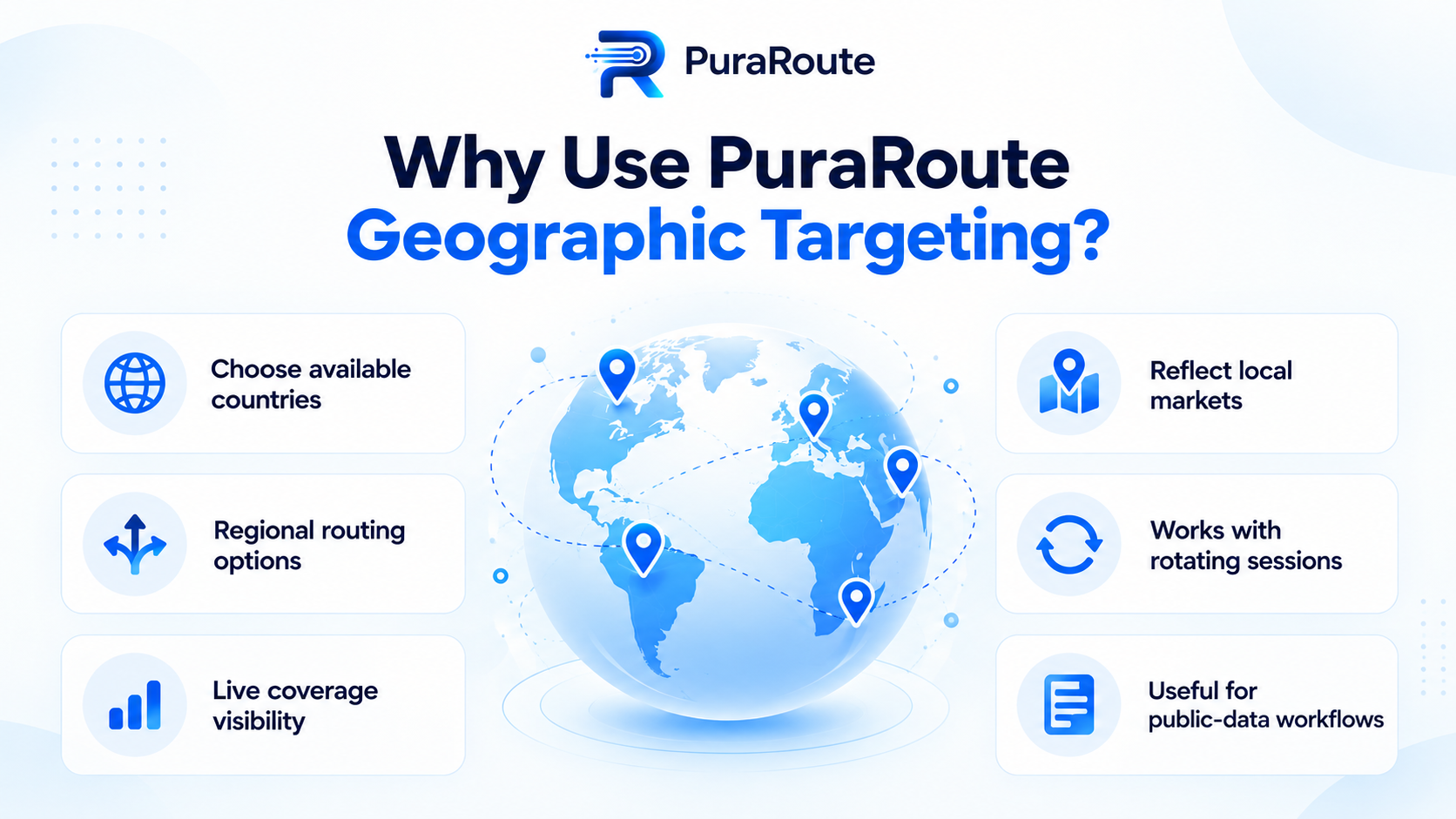
For regional price comparisons, select an available country and narrow to a state or city only when the job needs it. Keep the target URLs and site-side currency or delivery settings consistent across each comparison. If a collection requires several steps on the same temporary exit, use a Sticky session; use Rotating mode when the job calls for changing exits instead. Track purchased-traffic usage alongside accepted records so proxy costs enter the cost-per-record calculation. Neither session mode overrides the target's access rules or request limits.
What Data-Handling and Access Limits Should You Check Before Buying?
Beyond routing, access permission and data handling can rule out a scraper. Treat both as purchase requirements: technical access does not establish permission to collect or store data.
Confirm the permitted collection scope
Review applicable site terms, access requirements, and your organization's approval for the exact pages, fields, and intended use; public visibility alone does not settle legal permission. Exclude workflows intended to bypass access controls or account rules, and resolve unclear permissions with your legal or compliance team before buying software that relies on that collection scope.
Check where collected data and credentials will go
Ask vendors to document these controls before you upload sample data or connect accounts:
- Confirm storage locations, retention periods, and deletion procedures, including handling of personal or sensitive information.
- Verify who can access records, who owns exports, and how you retrieve them after cancellation.
- Keep credentials out of ordinary application logs.
Unresolved requirements should block purchase, even after a successful trial.
Which Option Should You Choose After the Trial?
Once access and data-handling checks pass, choose the candidate that meets mandatory requirements and supports its cost and upkeep claims with trial evidence. Leave unresolved candidates off the purchase order.
Choose by acceptance criteria, not the longest feature list
Reject tools that miss required fields or cannot deliver records into your workflow; use accepted output, recorded maintenance time, and total cost to judge those that pass. Keep the initial commitment small enough to match what the pilot proved.
Defer the purchase when no candidate passes
Do not buy around an unresolved failure.
- [ ] Record the failed requirement and evidence needed for a retest.
- [ ] Narrow the scope or test another collection method.
- [ ] Assign a fallback for missing or late data.
Frequently Asked Questions About best web scraping tools
Can a spreadsheet replace a dedicated web scraping tool?
A spreadsheet may be enough for a small, one-time collection. Check how you will import the data: manual copying, a supported import function, or an external connection. Test whether that method captures the rows and columns you need. Compare dedicated software when repeated updates, multiple pages, or cleanup make the spreadsheet workflow hard to maintain.
Can ChatGPT replace a web scraper?
ChatGPT can help draft extraction rules or explain scraping code, but do not assume your current setup can retrieve websites or run that code. Verify those functions separately. For recurring collection, test page access, execution, scheduling, and saved output. The best web scraping tools for your task must handle the collection steps you actually need.
Does AI-assisted extraction remove the need for human review?
No. Keep human review for important fields and unclear values, even when the output looks tidy. Check extracted prices against currency labels, dates against their source text, and missing values against the page. Test several page layouts before trusting a workflow. AI-assisted extraction does not make plausible-looking output proof of correct data.
Are customer review scores enough to choose a scraper?
Use reviews to find issues worth testing, not to make the final choice. Look for comments from people collecting similar pages at a similar scale. Then trial the scraper on your own sample. When comparing the best web scraping tools, check missing records, export formats, setup effort, and how much cleanup the results need.
Should I check for an official data API before buying scraping software?
Yes. First check whether the site offers an authorized API for the data you need. If one exists, compare its fields, access conditions, update frequency, usage limits, and cost with your requirements. Request a sample where possible. An API may simplify collection, but it may omit fields or older records your project needs.
Test your shortlist on a small sample of target pages, then compare data completeness, maintenance effort, and cost before scaling. If your collection workflow also needs residential IP rotation or geographic targeting, evaluate that infrastructure separately from the tool that extracts the data.
Try Puraroute Now
