
Two people put a proxy on the same account and ask the same question. One gets a complete answer. The other watches the reply stop mid-sentence around the fortieth second, then a red panel with a retry button.
Both used residential addresses from the same provider, on the same plan. The one that worked had a session window long enough to cover the answer. The other left rotation on.
A ChatGPT proxy gets discussed as a question of which address to pick. That is the second question. The first is how long the connection has to stay open, because one answer is not one request.
Why a ChatGPT Proxy Changes What the Browser Sends
The reply stopping halfway is the fastest way to see what the service actually examines, and it is not your question.
Where the Request Comes From and What It Carries
Every request carries three things that get compared against each other: the session cookie that identifies the account, the TLS handshake that reveals the client, and the exit address the packet arrives from.
That address resolves to a country, a city, and a network registration. The registration is the ASN, which identifies the operator holding that block of addresses. Nothing in the triple says anything about what you asked. What it says is whether the request looks like one person on one machine in one place, which is why an address that changes between turns of the same conversation reads as two separate sessions.
How the Answer Comes Back Through One Connection
A model does not compose a paragraph and then send it. It produces tokens, and they leave the server as they are generated, over the same HTTP response, which stays open for the length of the answer.
A long reply can run for the better part of a minute, and a slow one for longer. That single fact rearranges the problem. The connection is not a series of short exchanges; it is one socket held open while text trickles through it. If the exit address changes at any point in that window, the response ends where the change landed. What the reader sees is a sentence that stops and a retry button, which looks like a model problem and is not one.

Why the Browser and the API Need Different Sessions
Most confusion in this topic comes from two different things being called by the same name.
The web interface is a logged-in session in a browser. It depends on a cookie, it streams answers, and it behaves like a stateful application. Anything you do there happens inside one account's session.
The API is a key, a request, and a response. Each call stands alone, the answer is bounded by your own timeout, and no cookie survives between calls. A retry is a new request, not a resumed connection.
A ChatGPT proxy that suits the first is often wrong for the second, because a browser session needs an address that outlasts a conversation while an API call only needs an address that works.
Deciding What a ChatGPT Proxy Has to Hold
Once the answer is understood as a held connection, the design work reduces to one measurement, and it has nothing to do with coverage.
Why the Session Window Has to Outlast the Answer
Write down two numbers before buying anything: the longest answer you actually need to finish, and the sticky window the plan gives you.
A sixty-second window set against a ninety-second answer cuts the reply every time, on exactly the prompts you care most about. A five-minute window covers ordinary interactive use and costs nothing extra, because the window is a setting rather than a tier. Where plans differ is the ceiling. Some vendors cap it low, some let you set it, and that cap is the number that decides whether the plan fits at all.
Why a Stateless Call Needs No Sticky Window
Programmatic use inverts the requirement. Each API call is independent, so rotation is harmless and coverage becomes useful: a hundred checks that each leave from a different city is exactly what a rotating pool is for.
What changes is the price of failure. A cut stream costs a retry. An API call that you retry automatically costs a second request, a second charge against your token budget, and a second entry in the rate-limit count. Retry logic written for an ordinary endpoint, with five attempts and no backoff, is how a working integration turns into a wall of 429 responses.
Account Region Is Not the Exit Address
This is where most guides make a claim that does not survive contact with the product.
A proxy changes one thing: the address a request leaves from. It does not change the country recorded on the account, the plan attached to it, the payment method, or the history of the session. Where availability is decided from the account record rather than from the address on a single request, a different exit does not move it, and buying more addresses will not either.
The terms sit on a separate layer again. They govern how you reach the service and what you do with it, not which network the packets came from. Running traffic through an exit in another country is a network decision. Automating the interface, or sharing one account beyond what the terms allow, is an access decision, and no proxy setting answers for it.
How to Set Up a ChatGPT Proxy
Three requirements are now on the table: a window, a rotation policy, and an address. The next choice is where the configuration lives, because that decides how much of the machine a ChatGPT proxy touches.
Whether the Proxy Sits at System Level or Profile Level
A system proxy applies to everything the machine does. The browser you meant to route, the one you forgot about, the updater in the background, and any application that reads system settings all leave through the same address.
A profile-level proxy applies to one browser profile. Two profiles can then sit on two addresses at once without interfering, which is the point of separating them.
For a single personal account in one browser, either works. The moment a second profile exists, system level stops being neutral: both profiles share one exit and the separation you were building is not there.
Which Fields Have to Be Right and Why
The panels differ more than the labels suggest.
HTTP and HTTPS are separate fields even when the values are identical, so they get filled twice. A browser that sends plain HTTP through the proxy and HTTPS straight out looks configured and is not.
The SOCKS panel in macOS and the manual proxy dialog in Windows both take a host and a port. Neither has a field for a username and password, so an authenticated SOCKS5 endpoint cannot be entered there. That is not a bug to work around; it is a reason to keep a SOCKS endpoint allowlisted by source address instead.
One more detail that costs people an hour: 127.0.0.1 in that field means the browser will try to reach a forwarder running on the local machine. If nothing is listening, every request fails instantly with a connection error and the proxy is never contacted.
What to Check Before the First Prompt
Do these in order, before the account is used at all. Running them after a failed answer means the failure was your test.
- Load an unrelated page and confirm the exit address on two independent lookup services. Compare the city as well as the address.
- Compare that city with the browser's timezone and language settings. An address in Frankfurt under an
Asia/Shanghaiclock is a mismatch that survives any amount of retrying. - Ask something that produces a long answer and let it run to the end without touching the window. This is the only check that exercises the connection for the length that matters.
What Breaks a Streaming Connection
Configuration errors are quick and loud. The failures that waste weeks are quiet, and all three are timing problems rather than settings. A ChatGPT proxy can pass every field test in the previous section and still cut an answer in half.
The Answer Stops Halfway
Three causes produce the same screen, and they separate by when the cut happens.
A cut at the same elapsed second every time points at a timeout: either the proxy's idle limit is shorter than the answer, or the sticky window expired. A cut at random points, sometimes after twenty seconds and sometimes after two minutes, points at rotation. A cut that only lands on the second question of a conversation points at a session that ends when the previous response closed.
Recording the elapsed time of each failure for a day separates these three faster than any diagnostic tool.
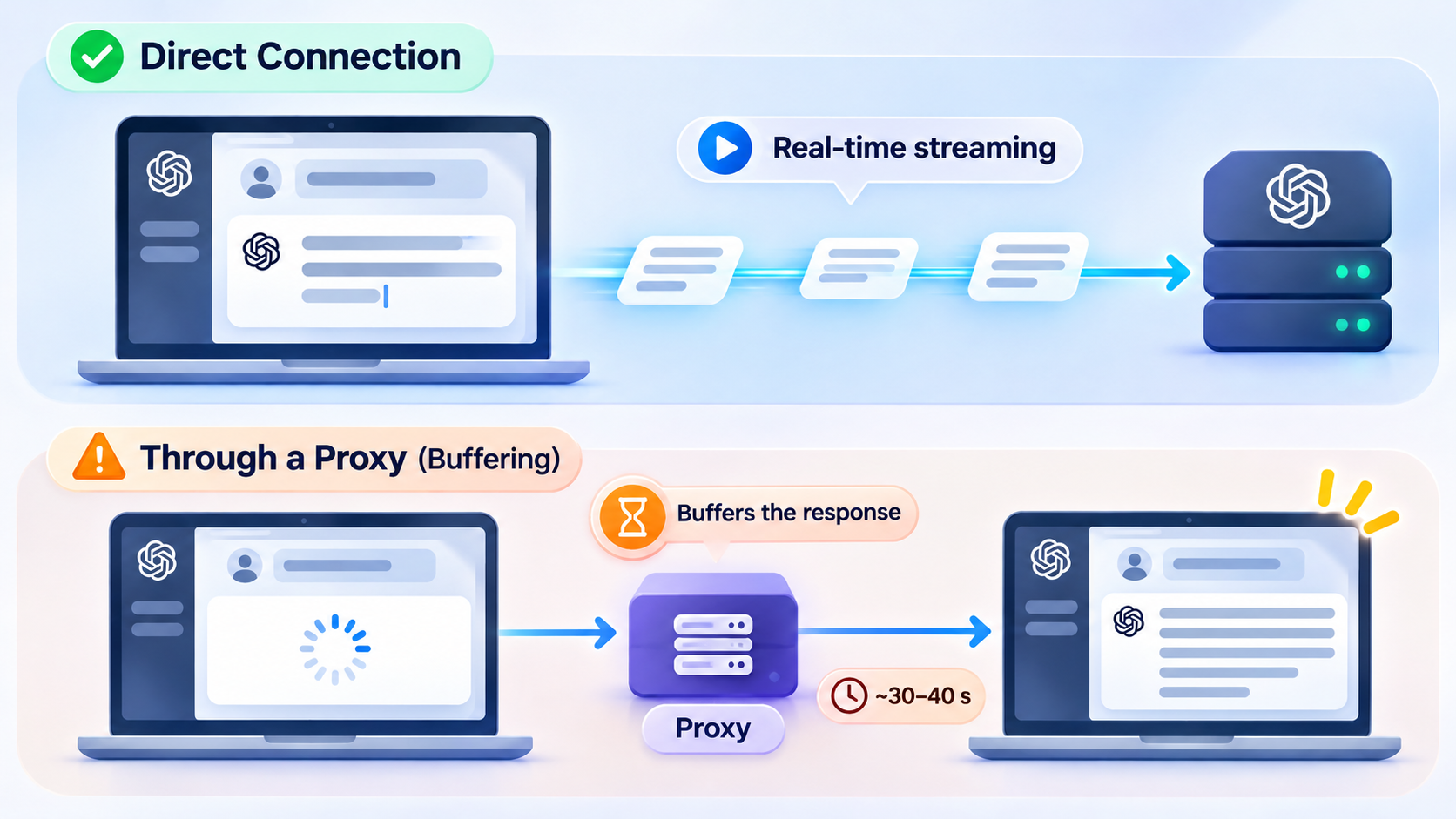
The Text Lands All at Once
Some proxies buffer. They accept the whole upstream response, hold it, and hand it back in one piece when the server closes the connection.
The symptom is distinctive: a blank panel for thirty or forty seconds, then the entire answer appearing at once, usually with a spinner that kept turning while nothing seemed to happen. Nothing is wrong with the account and nothing is wrong with the model. The streaming behaviour the interface depends on was removed by a hop in the middle.
The test is a comparison. Connect directly, ask the same question, watch the text arrive word by word. If it only arrives at the end through the proxy, the proxy is the difference.
The Password Prompt Returns
A 407 is not an account problem and not a ChatGPT problem. It means the proxy received the request and asked for credentials that either did not arrive or did not match.
Three causes cover most of it: the credential was never saved and the prompt is being dismissed instead of filled, a special character in the password was escaped one way when generated and typed another, or HTTP and HTTPS each store a separate entry and only one was updated.
A fourth version is quieter. An account restricted to an IP allowlist rejects the connection before it reads any password, so correct credentials fail exactly like wrong ones. The same login-over-a-proxy checks, including how a 407 differs from a 403, show up in the write-up on proxy with Gmail, which follows the same authentication path.
How the ChatGPT Proxy Options Compare
None of the failures above came from the address type, but the address type decides what is seen before any of them can happen.
| Exit type | What the ASN shows | Browser session | API calls | Typical failure |
|---|---|---|---|---|
| Residential | Consumer ISP | Fits, with a window that covers the answer | Workable but wasteful | Rotation mid-stream |
| Datacenter | Hosting provider | Poor, the range is identifiable | Fits, servers are meant to call from servers | Refused at the edge |
| Free public list | Mixed, often hosting | No | No | Address disappears or is shared |
Why Residential Exits Fit a Browser Session
A residential address is registered to a consumer ISP, so it resembles a home connection because that is what it is.
For a ChatGPT proxy used inside a logged-in browser session, that resemblance is the whole value. The address does not need to be fast, and it does not need to change every request. It needs to remain the same for the length of the conversation, which is a session setting rather than a property of the pool.
Where a Datacenter Exit Actually Belongs
Datacenter addresses are identifiable, and nearly every guide uses that as an argument against them. In this workflow the argument is half true.
Against a browser session that claims to be a person at home, a hosting range is an obvious mismatch. Against an API client, a hosting range is the normal case: servers call APIs from servers, and a request from a datacenter is what that traffic is supposed to look like. Buying residential traffic for a script running on a server pays a premium for a disguise nobody asked for.
What a Free Proxy List Actually Costs
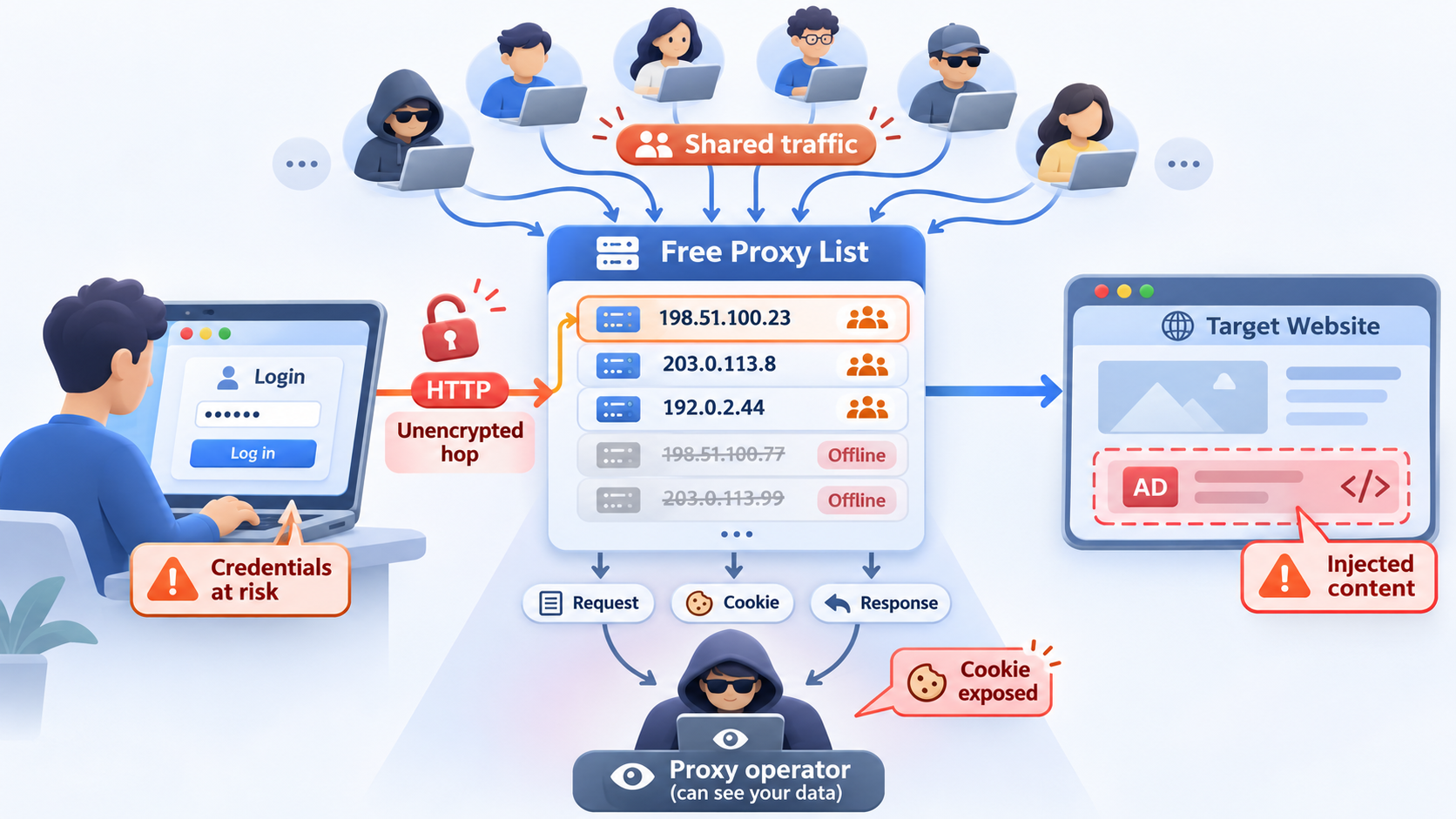
A published list is a list of addresses anyone can use, so each entry already carries other people's traffic by the time you reach it.
The mechanics matter more than the crowding. Many entries are plain HTTP proxies, which means the hop between you and the proxy is unencrypted and the operator can read both the request and the response. Some inject content, some log credentials, and most disappear within weeks. For a service where every request carries a session cookie, that is the wrong place to save money.
How to Send Requests Through a Proxy From Code
Browser settings do not reach a script, which is why a ChatGPT proxy that works in a browser can fail in code with no visible error at all.
What Environment Variables Do and Where They Stop
The standard variables are HTTPS_PROXY and ALL_PROXY, and most HTTP libraries read them without any configuration. That is convenient and blunt: the setting applies to the whole process, including calls you never meant to route.
NO_PROXY is the counterweight. List internal hosts there and those calls go direct while everything else leaves through the proxy. Skipping it is how a health check that used to answer in milliseconds starts timing out.
When the Client Ignores the Environment Variables
Not every client looks. Node's built-in fetch does not read those variables, so a Node integration can have a correct HTTPS_PROXY and still connect directly. The client needs a proxy-aware dispatcher passed in.
The Python SDK is the opposite case. Its HTTP layer reads the environment, and a custom HTTP client can carry a per-client proxy for the calls that need one, which is cleaner when only some requests should be routed.
How Secrets, Allowlists and Retries Interact
Two credentials now sit in the same config file: the API key, plus the proxy username and password. Both end up in logs and screenshots. An allowlist removes the second one entirely, leaving a single secret to rotate.
Retries deserve their own rule. A retried call is a new request, billed and rate-limited separately, so the retry budget is part of the traffic budget. Backoff with a ceiling, plus an idempotency check on the caller side, keeps a transient error from turning into an invoice.
What to Check Before Committing to a Plan
Everything above can be verified on a trial, and the verification takes an afternoon rather than a month. A ChatGPT proxy that passes these three checks is not automatically good; one that fails them certainly is not.
Which Session Controls the Plan Lets You Set
Ask for three values before the trial ends:
- Whether the sticky window is yours to set or fixed by the plan.
- What the ceiling is, in minutes.
- Whether rotation can switch to per-request for calls that need no continuity.
A provider that cannot state the ceiling in one sentence has not built the feature for this use case.
How Narrow the Targeting Goes and Whether Stock Is Visible
Country, state, city and ASN are four granularities, and the one you need depends on what you are comparing. Check availability for the specific city before designing a workflow around it, because stock moves and a plan bought for an empty region costs a billing cycle.
Which Billing Unit Fits Which Request Pattern
Traffic billing suits work that starts and stops. Per-IP billing over a term suits an address that has to be identical for weeks. Buying per gigabyte for a session that is always open, or per IP for a wide crawl, pays for the wrong shape; the comparison of dynamic vs static residential plans walks through that decision in more detail.
Where These Requirements Meet a Real Console
Buying the wrong shape for a ChatGPT proxy is the failure the last section described, and it tends to surface a month after payment rather than during a trial. Three questions catch it earlier, and none of them is about price: how long a single address can be held, whether that ceiling is a setting or a fixed property of the plan, and whether a metered pool and a permanent address come from the same account.
Those three separate a supplier that sells access from one that resells it. They also decide whether a workflow can change shape without being rebuilt somewhere else, which is the part most people find out too late.
How the Three Requirements Map to Three Session Controls
Session control is where the three requirements stop sharing an answer. A call that finishes in two seconds and a session that has to survive a ninety-second reply do not want the same policy, and neither of them wants whatever keeps an address unchanged for a month. On the supplier side these are separate settings rather than one dial turned to different values, and the question worth asking is whether a single account exposes all of them.
If the work is a stream of independent calls, rotation per request is the right default and there is no session to protect. If a conversation has to stay on one exit, a sticky window does it, and the number that matters is how long the window is allowed to be. If the address itself is what gets compared month over month, nothing short of a dedicated IP held for the term will produce that.
PuraRoute runs all three from one account, with the sticky ceiling at 120 minutes and no cap on concurrent sessions. Plan structure for the metered side is on the rotating residential exits page.
Which Exit Types Exist and What Each One Is For
Exit type is decided by what the target reads, not by which grade sounds better. A session that has to look like a home connection needs an address registered to a consumer ISP. A target that checks the registration record against the physical location needs the two to agree. Getting this wrong is not a quality problem, it is answering a different question than the one being asked.
From there, targeting is about how narrow the answer has to be. Country-level selection is enough to change which regional version of a service you reach. City coverage is what makes a session look local rather than merely national. ASN is for the cases where the operator itself is being compared.
PuraRoute carries rotating residential, static residential, static native and US carrier native addresses, with selection from country through state and city down to ASN. City-level choice is part of the plan rather than an upgrade, which is what makes a same-city exit usable for everyday work instead of a special purchase. IP allowlisting and traffic statistics sit in the same console, and the dedicated static IPs page covers the fixed-address side.
A proxy decides where the request leaves from. It does not decide what the account does, how many of them exist, or how the service judges either. Those stay with you, and no plan changes them.
Frequently Asked Questions About ChatGPT Proxy
Five questions come up often enough to answer plainly.
Can You Use a ChatGPT Proxy on Mobile?
Yes, at the operating system level. iOS takes a proxy per Wi-Fi network under that connection's advanced settings, and Android does the same for each saved network. Neither platform offers a per-app proxy for a browser.
The practical consequence is that every app on the phone uses that address while it is set, including the ones that break when they suddenly appear in another country.
Is a ChatGPT Proxy Against the Terms?
Routing traffic through an address is not what the terms discuss. They govern how you reach the service and what you do with the account, and the current text is public on the OpenAI terms page.
That distinction points at what to be careful about. A proxy is a network decision. Automating the interface, reselling access, or sharing one account beyond what the terms allow is an access decision, and a proxy neither authorizes it nor hides it.
Does a Proxy Change Response Time?
It adds one hop, so it adds latency. An exit in the same city as your connection is close to invisible. An exit on another continent adds tens of milliseconds before the first byte arrives, and the answer streams at the speed of the connection from there.
What a proxy does not do is make the model faster. If answers got slower after a change, the hop grew; the generation did not.
How Do You Test a ChatGPT Proxy?
Three checks, in order: the exit address differs from your own and resolves to the city you ordered; a long answer streams from the first word to the last without a gap; the address is still the same when the answer finishes.
The third one is the check most people skip, and it is the only one that catches rotation set wrong.
Why Does the Page Load but No Answer Arrives?
The interface and the answer travel on different paths. The page arrives as static assets from a cache near you, which is why it opens instantly even when nothing else works. The reply comes from an endpoint that has to reach the model.
A proxy that passes cached files and blocks that endpoint produces exactly this: a fully rendered page, a spinner, and no text. Checking the exit address will not explain it. Watching the network panel for the request that stays pending will.
Conclusion: What Has to Stay Fixed and What Can Move
The question that decides everything else is how long one answer holds the connection. A ChatGPT proxy that cannot keep one address for that long will fail on the prompts worth asking, however good the pool is.
Getting the order wrong produces most of the frustration. An address gets bought for coverage, rotation stays at its default, and the cuts that follow get blamed on the model, the account, or the provider, in that order, none of which is where the problem is.
A proxy decides where the requests leave from. Whether they should be leaving at all, and under whose account, is a question the pricing page does not answer.
