
Carrier addresses are the most expensive way to move a gigabyte, and the invoice is the part teams forget to model. A price-monitoring run that costs pocket change on residential traffic can clear a month of budget on mobile, returning the same record count and reading the same pages.
What a mobile proxy server sells is an address a carrier issued, shared with thousands of ordinary subscribers through carrier-grade NAT, on a network that no blocklist classifies as hosting. That combination is worth paying for in a narrow band of jobs and wasted everywhere else. The rest of this page is about telling those apart before the invoice arrives.
What Problems Can a Mobile Proxy Server Solve?
Start with where the address comes from. Every limitation further down this page follows from that one fact.
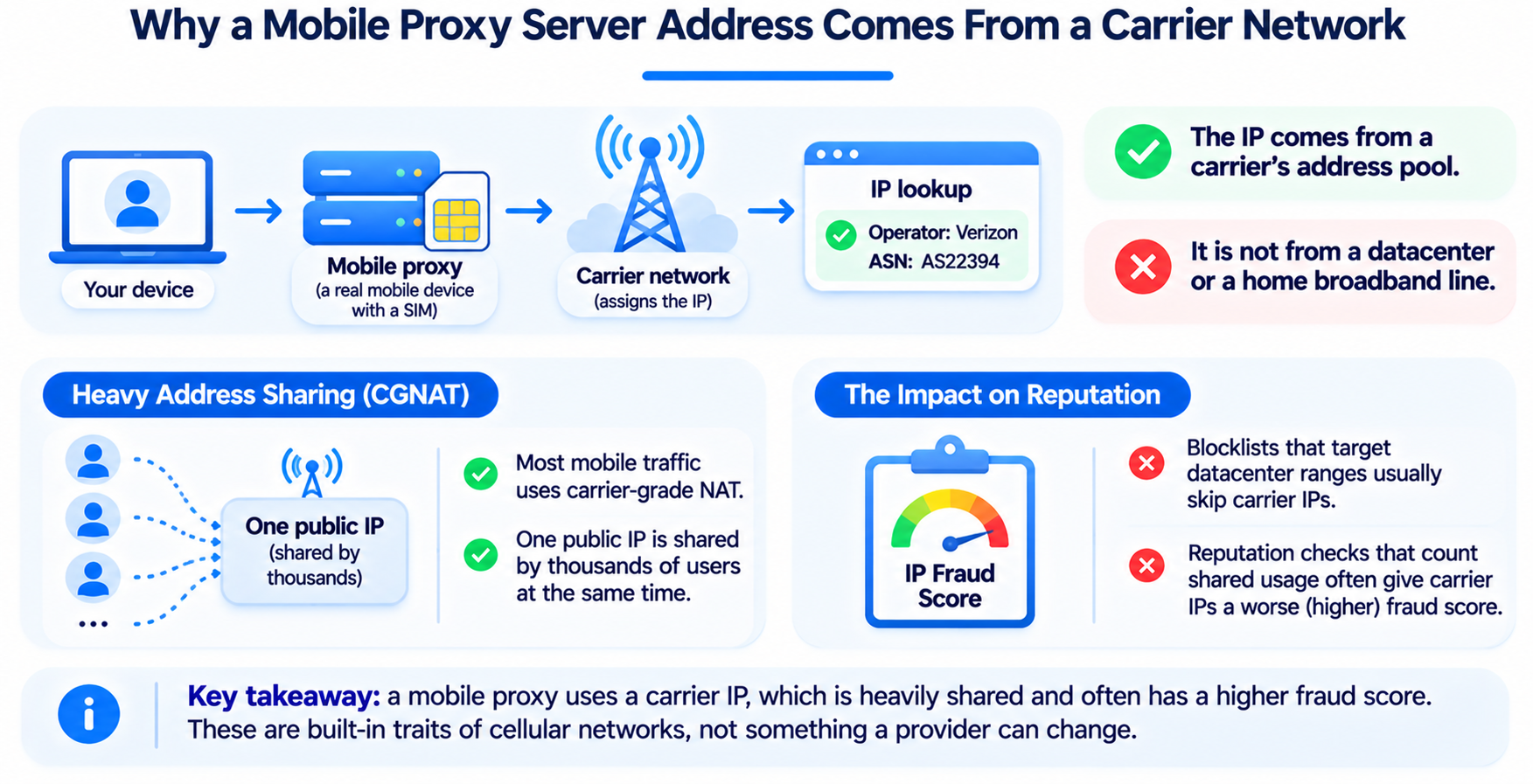
Why a Mobile Proxy Server Address Comes From a Carrier Network
A mobile proxy server routes your request out through a device that holds a SIM card on a cellular network. The carrier assigns the address from its own pool, so a lookup of that address returns the operator's name and its autonomous system number, not a hosting provider and not a home broadband account.
Carriers also share addresses far more aggressively than wireline providers do. Most mobile traffic in the world sits behind carrier-grade NAT, where thousands of subscribers use one public IPv4 address at the same time. That has a consequence most people miss: the address your traffic leaves on is the same address a few thousand strangers are using right now for ordinary browsing. Blocklists that key on datacenter ranges skip it, and reputation checks that count shared usage score it badly, which is why an IP fraud score reads worse on a carrier address than on a home line.
Both of those effects are structural. Neither is a detection trick, and neither can be tuned by choosing a better provider.
Where Carrier Addresses Keep a Data Job Running
Three task shapes come up again and again, and they are worth separating because they fail differently.
The first is a target that treats carrier traffic as a different product. Some app APIs only answer requests that arrive from a mobile network, and mobile web pages serve different markup, different prices and different stock states than the desktop version. A request from a datacenter address to those endpoints either gets refused or gets the wrong page.
The second is verification work. Checking which ad creative renders on a phone in a specific market, or whether a promotion actually applies to mobile visitors, needs an address a carrier would issue.
The third is a consumer-facing site that has tightened its rules past what residential addresses survive. Marketplaces and travel aggregators are the usual examples. The carrier tier is the last step in that escalation, not the first, and it is the most expensive one.
When a Mobile Proxy Server Beats Residential and Datacenter Addresses
Datacenter addresses are fast, cheap and easy to classify, which is exactly why strict sites refuse them. Residential addresses cover far more locations for a fraction of the cost per gigabyte, and they handle most collection work. Mobile addresses only win where the site itself distinguishes carrier traffic, or where the endpoint is mobile-shaped in the first place.
That is a narrow band, and widening it costs money. A team that reaches for carrier addresses on every project pays mobile rates for records a residential exit would have returned unchanged. The judgement to make is whether the target behaves differently for carrier traffic. If it does not, mobile buys nothing.
What Risks Are Involved With Mobile Proxy Servers?
Cost is the risk people notice first and the least expensive one.
What a Mobile Proxy Server Provider's Terms Require of You
Two sets of terms apply, and they are not the same document. Your provider's terms govern how the traffic is carried. The target site's terms govern what you are allowed to do once your request arrives. A proxy changes the address a request leaves from; it changes nothing about permission.
Where the traffic physically comes from matters too. Some providers run their own modems and SIM cards. Others operate SDK networks, where consumer apps installed on ordinary phones route a slice of traffic in exchange for in-app rewards. The second model is cheaper and depends on those users having agreed to it, which is a question about the provider's practices rather than yours. It is worth asking before you buy, and worth checking whether the arrangement is lawful in the markets you operate in.
None of this is legal advice, and rules differ by country. Treat it as a list of questions to put to a provider.
Which Mobile Proxy Server Mistakes Burn Budget Fast
Mobile traffic is billed by the gigabyte at the highest rate in the category, so waste is expensive in a way it is not elsewhere.
- Retrying a failed request with no backoff, five times, on a page that weighs two megabytes.
- Holding a long sticky session while the script reloads the same category page repeatedly.
- Pulling full HTML with images and fonts for a task that needs one price field.
- Using a mobile proxy server for a bulk archive job that a datacenter range would finish in an hour.
A single misconfigured retry loop can consume a week of budget in an afternoon, and the bill arrives without a per-target breakdown unless you build one.
What a Mobile Proxy Server Cannot Do
The address is the only thing it controls. It does not align your request headers with the browser you claim to be, it does not fix a TLS fingerprint that belongs to a Python library, and it cannot answer a CAPTCHA on your behalf. It also does not keep an account alive; account survival depends on what the account does, from which device, and how the platform scores the session.
Teams that expect one address to carry the whole job end up blaming the provider for a result their own client produced.
How to Choose the Right Mobile Proxy Server in 2026
Once you know the task needs a carrier address, the choice narrows to a handful of attributes that can be checked before payment.
Which Features Decide Whether a Carrier Address Fits Your Task
Protocol support comes first. HTTP and HTTPS proxies with CONNECT handle web traffic; SOCKS5 handles TCP and, with UDP association, datagrams as well. The SOCKS5 specification covers authentication negotiation and the address types a client can request, which is why the protocol handles hostnames without local DNS resolution.
Session control comes second. A provider either rotates the exit on every request or holds it for a window you specify. Some expose both through a session identifier appended to the username.
Then coverage. Mobile exits are usually sold by country because carrier pools are national. A provider promising city-level mobile targeting in twenty countries is worth a second question.
Finally the resource model. Modems and SIMs the provider owns behave differently from an SDK pool: fewer addresses, steadier ones, higher price. Ask which one you are buying, and ask whether the address stays yours for the whole term.
How Mobile Proxy Servers Compare With Residential and Datacenter Proxies
The three are not ranks of quality. They are different ownership models, and each one fails a different way.
| Mobile | Residential | Datacenter | |
|---|---|---|---|
| Who owns the address | a mobile carrier | a home broadband subscriber | a hosting provider |
| How a site classifies it | carrier network, shared through carrier-grade NAT | ISP residential range | hosting range |
| Billing unit | gigabytes, highest rate | gigabytes, lower rate | IPs, usually per month |
| Session behaviour | can change on reconnect | fixed, rotating or sticky | static for the term |
| Where it fits | mobile-shaped endpoints, strict consumer sites | general collection, geo checks | speed, volume, your own infrastructure |
The row that decides most projects is the billing unit. Datacenter proxies are sold by address, so a hundred parallel workers cost the same as one. Mobile proxies are sold by traffic, so concurrency is nearly free and volume is not.
How to Judge Speed, Reliability and Cost of a Mobile Proxy Server
Radio access adds latency before any server work happens. A round trip over a cellular network typically lands between 40 and 100 milliseconds, with more jitter than a wireline connection, and a request that leaves through a handset picks up whatever congestion that cell has at that moment.
Do not take the vendor's number for it. Send two hundred requests to one target, log the status code, the exit address and the byte count for each, and compute p95 latency rather than the average. Then compute cost per successful record: gigabytes consumed divided by records returned, times the rate. That number, not the price per gigabyte, tells you whether the plan is affordable for the task.
When a Mobile Proxy Server Is the Wrong Choice
Four cases are clear enough to name.
A bulk crawl of static pages does not need a carrier address, and the budget is better spent on volume. Work that needs one address for weeks needs a fixed residential or ISP address instead, because mobile addresses move with the connection. Tasks that depend on city-level targeting rarely get it from mobile pools. And a team running dozens of workers on a fixed monthly budget will find mobile billing unpredictable in a way datacenter billing is not.
How to Set Up a Mobile Proxy Server
Setting one up takes five minutes. The failures come from what surrounds it.
What a Mobile Proxy Server Setup Requires Before the First Request
You need five values from the provider: host, port, protocol, username and password. Credentials are the only authentication a proxy connection uses, so the username and password go into the client configuration, or into a Proxy-Authorization header if you build the request by hand. Where a provider offers IP allowlisting, it usually governs API access rather than the proxy connection itself, so do not count on it to replace a password.
If the provider supports sticky sessions, the session identifier belongs in the username, usually as a suffix. If it supports targeting, country and region go there too, in the format the provider documents.
How to Connect a Mobile Proxy Server to Your Scripts and Tools
- Put the credentials in environment variables so they never enter the repository.
- Send one request to an endpoint that echoes your address, and record the address and its ASN.
- Confirm the ASN belongs to a carrier rather than a hosting provider. If it does not, you are connected to the wrong endpoint.
- Set a connect timeout of about twenty seconds and a read timeout of sixty.
- Add the session identifier if the flow needs the same exit across several requests.
- Log the status code, exit address and byte count for every request from the first run.
- Raise concurrency only after the single-threaded run is clean.
Browsers are the exception. A browser holds one upstream proxy setting, so a mobile endpoint goes in at the system or profile level, and an application that ignores system settings never sees it at all.
How to Troubleshoot a Mobile Proxy Server That Will Not Connect
A 407 means the credentials did not arrive; check for characters in the password that need URL encoding, and confirm the username is not truncated at the session suffix. A 502 or 504 usually means the upstream device is offline, and retrying on a second endpoint is faster than waiting.
Timeouts before any byte arrives point at DNS or at the radio link, not at the target. A TLS error immediately after connecting is almost always a protocol mismatch, where the client speaks HTTP to a SOCKS5 port or the reverse. If curl works and the browser does not, the chain is fine and the application is the problem.
How to Use a Mobile Proxy Server for Web Scraping
Scraping is where most of the budget goes, and where most of it is wasted. The client decides what a page costs before the request leaves: a headless browser pulling images and fonts spends traffic a plain HTTP client never touches, so web scraping tools and the proxy get picked together rather than one after the other.
What Makes a Mobile Proxy Server Scrape Fail Mid-Run
Runs rarely fail at the start. They fail after a few hundred requests, when a pattern becomes visible.
Request rate per exit is the first cause. Sending forty requests a minute through one address looks nothing like a phone, whatever the address belongs to. Concurrency on a single session is the second: several parallel workers sharing one sticky exit produce a burst no handset generates.
The third is the request itself. Missing or misordered headers, a client that cannot render JavaScript, and a timezone that disagrees with the claimed location will each produce failures that look random until you compare them against the exit address. A mobile proxy server changes the address; it does not make a headless client look like a phone.
How Rotation Timing Affects a Mobile Proxy Server Session
The rotation interval should follow the task, not the provider's default.
Per-request rotation suits independent pages: catalog listings, product records, search results. A sticky window of five to ten minutes suits a sequence that has to stay coherent, such as a paginated list or a cart flow, because the site ties those steps to one address. Long sessions suit logged-in work, with one caveat: mobile addresses can change when the device reconnects, so the session identifier has to carry the continuity rather than the address.
To find the interval, start short and lengthen it. Error rate falls as the window grows, up to the point where it flattens. That point is the interval your target tolerates, and it is usually shorter than people assume.

What a Mobile Proxy Server Does and Does Not Hide
It hides the address your request started from. The site records the carrier address instead, and that is the whole of the guarantee.
It does not align your TLS fingerprint with the browser in your user agent, it does not match header order, it does not fix a cookie history that belongs to a different session, and it does not change what the account does next. DNS is the other gap: if your client resolves hostnames locally, the query leaves from your own network even though the traffic does not.
Anyone treating the address as a complete disguise will be disappointed by the first site that looks at more than the address. Anyone treating it as one layer, with the client built properly underneath, gets what they paid for.
How to Keep a Mobile Proxy Server Working Long Term
Two weeks in, the numbers drift, and nobody notices until a job returns half its usual rows.
How to Monitor Mobile Proxy Server Performance Over Time
Track five figures per target, daily:
- success rate, split by status code family
- p95 latency per endpoint
- gigabytes consumed per thousand successful records
- share of 407, 429 and 5xx responses
- distribution of exit ASNs
Compare the ratios rather than the totals. Success rate falling while volume holds steady is a target-side change. Volume falling with success steady is a client-side change. A rising byte count per record is usually images or a redirect loop nobody noticed.
How to Maintain a Mobile Proxy Server Setup as It Ages
Rotate credentials on a schedule and immediately after anyone with access leaves. Remove endpoints that stop answering instead of letting the client retry them. Keep the configuration in a secret store rather than in a config file that ships with the code. Pin the client library version, because proxy libraries change authentication handling between releases more often than their changelogs suggest.
Re-run the baseline test after any provider announcement. Carrier pools get reallocated, and an address that behaved one way last month can be classified differently this month without anyone telling you.
Signs That a Mobile Proxy Server Has Been Compromised
Three signals are worth an immediate check. Bandwidth climbs while request volume stays flat, which means something else is using the connection. Requests appear from addresses you never configured, which points at a leaked credential. Credentials show up in a log file, a screenshot or a repository commit, which happens more often than teams admit because the username field is where people paste their debugging output.
Rotate first, then investigate. An endpoint that answers for someone else's traffic is billing you for it.

How PuraRoute Covers Carrier and Residential Exits
Two of the fixes above, rotating a credential and retiring an endpoint that stopped answering, depend on what the console shows you: which resources are still alive, when each one expires, and how much traffic it has burned. The purchase decision sits in the same view, and it comes down to whether the work needs an address that holds for the length of a term or one that changes on demand.
Fixed Carrier Native IPs for Work That Needs One Address
When the exit has to be a carrier address that does not move, the carrier native proxies tier runs on United States carrier networks with a fixed IP, sold in 7, 30 and 90 day terms over HTTP(S) and SOCKS5. It sits above the standard static native tier for platforms with strict risk controls, and the console shows host, port, protocol, credentials and expiry date for each resource, with manual and wallet-based auto-renewal.
For teams whose accounts are tied to one address, that fixed term is the point: the address is the identity, and changing it mid-project means starting the account's history again.
Rotating Residential Exits When Coverage Matters More Than Permanence
When the task needs reach rather than permanence, the residential proxy network covers 195+ countries and regions with country, state, city and ASN targeting, and a session that either rotates per request or holds an exit for a defined window. Parallel connections are available for collection work, and the console reports traffic usage so the cost per record stays visible.
Carrier native is a United States product, so a test aimed at another market runs entirely on the residential network, where the bill is measured in gigabytes instead of IP count and term.
Frequently Asked Questions About Mobile Proxy Server
Are Mobile Proxy Servers Legal to Use?
In most countries the proxy itself is lawful; what matters is what you do through it and whether the target site's terms allow it. Two things to check before buying: whether your provider's network depends on consumer devices that opted in, and whether your jurisdiction restricts the traffic you plan to send.
Can a Mobile Proxy Server Be Used for Social Media Automation?
Technically yes, and it is common for managing a small number of accounts that each need a stable address. What a mobile proxy server does not do is make automated posting look like a person. Platforms score device signals, timing and behaviour, so the address is one input among several.
How Does a Mobile Proxy Server Affect CAPTCHA Challenges?
It changes the address a challenge is scored against and nothing else. Carrier addresses are shared with many ordinary subscribers, which can mean less friction on some sites and more on others where shared usage is itself a signal. No proxy answers a challenge for you.
How Do 4G and 5G Mobile Proxy Servers Differ?
Both hand out carrier-assigned addresses through the same kind of NAT. The practical difference is latency and pool size: 5G links usually return faster round trips and some providers expose newer address ranges on them. Neither is inherently cleaner, and a 5G address that many users share scores the same as a 4G one that does.
Do Mobile Proxy Servers Work With Every Device and App?
No. A phone or a desktop can be pointed at one, but an application that ignores the system proxy setting never touches it, and anything relying on raw UDP usually needs a different route altogether. Most teams end up configuring the proxy per process rather than per device.
Conclusion
Everything above reduces to one comparison you can run in an afternoon: identical requests through a carrier address and through a residential one, then a diff of the two responses. Same markup, same prices, same status codes means the target never cared where the request came from, and a mobile proxy server is an expensive way to learn that.
Where the responses differ, the premium has already justified itself and the remaining work is holding the endpoint steady. Where they do not, the budget belongs in volume. Buying first and diffing afterwards is the order that produces invoices nobody can explain.
