
A dedicated residential proxy gives you exclusive access to a residential IP address. It can be useful for businesses that need a consistent network location, regular access to online accounts, or more control over their proxy connections. Unlike shared proxies, a dedicated residential proxy is reserved for one customer during the rental period.
However, not every dedicated residential proxy offers the same features. IP quality, connection speed, location coverage, and pricing can vary between providers. This guide explains how dedicated residential proxies work, their benefits and common use cases, and how to choose and set up the right proxy for your needs.

What Is a Dedicated Residential Proxy?
A dedicated residential proxy is a proxy server that gives one customer exclusive access to a residential IP address. The IP comes from a network linked to an Internet Service Provider (ISP), rather than a typical datacenter IP range. Unlike shared proxies, a dedicated residential proxy is not used by other customers during your rental period. This gives you more control over how the IP is used and helps reduce problems caused by other users sharing the same address.
For example, imagine you manage an online store and need to access its dashboard every day. Using a shared proxy means other customers may also send traffic through the same IP. Their activity could affect how some websites treat that address. A dedicated residential proxy removes this shared-use issue and gives your store a more consistent network setup. However, it does not guarantee that websites will trust your connection or that your account will avoid security checks.
How Does a Dedicated Residential Proxy Work?
A dedicated residential proxy works as a middle point between your device and the website you want to visit. Instead of sending your request directly to the website, your browser sends it through the proxy server. The server forwards the request using its assigned residential IP address. The website sees the proxy's public IP instead of your device's original public IP. When the website sends a response, the proxy passes that data back to your browser.
For example, suppose you run an e-commerce business in Canada but need to review your US store from a US network location. You can connect your browser to a dedicated US residential proxy. When you visit the store, the website receives your request from the US proxy IP. If the proxy is static, you can keep using the same address across multiple sessions. This is useful when your work requires a stable network location over time.
The exact setup depends on the provider. Some dedicated residential proxies use IP addresses linked to real home internet connections, while others use ISP-registered addresses hosted on server infrastructure. The second type is often sold as a static residential proxy or ISP proxy. Before buying, check where the IP comes from and whether it stays the same during your subscription. For a closer look at these network types, see this guide to residential proxies vs. ISP proxies.
Dedicated Residential Proxy vs. Regular Residential Proxy
Both dedicated and regular residential proxies use IP addresses associated with residential internet networks. The main difference is how those IPs are assigned and shared. A dedicated residential proxy reserves an IP for one customer, while many regular residential proxy services use a shared pool of addresses. These shared services often rotate IPs after each request or at set times, although some let you keep the same IP for a limited session.
For example, a market research team collecting public product prices from different regions may prefer rotating residential proxies. The team can use different IP addresses as it checks prices across locations. However, an online store manager who needs regular access to the same business account may prefer a dedicated residential proxy. Keeping one IP can make the network setup easier to manage and reduce unwanted changes between sessions.
The table below shows how these options usually compare.
| Feature | Dedicated Residential Proxy | Regular Residential Proxy |
|---|---|---|
| IP access | Exclusive to one customer | Often shared through an IP pool |
| IP changes | Usually fixed, but depends on the plan | Often rotates or uses sticky sessions |
| IP control | Greater control over assigned IP | Less control over individual IPs |
| Cost | Often higher per IP | Often charged by data usage |
| Best suited for | Long-term sessions and account management | Regional research and large-scale data collection |
These differences reflect common service models, not fixed rules for every provider. Some residential proxy plans offer private rotating pools, while others provide shared static IPs. Always check the actual service terms before choosing a plan.
Dedicated IP vs. Static IP: What's the Difference?
The terms dedicated IP and static IP are often used together, but they describe different features. A dedicated IP is an address reserved for one customer during a set period. A static IP is an address that stays the same instead of changing often. In simple terms, dedicated describes who can use the IP, while static describes whether the IP changes. An IP can be dedicated, static, or both.
For example, a company may use a static IP to access a business system that only accepts requests from approved addresses. If that static IP is shared with other customers, it is not dedicated. On the other hand, a provider may assign a customer an exclusive residential IP that changes after a set time. That IP is dedicated during the assigned period, but it is not permanently static.
For businesses that need both stable access and exclusive use, a dedicated static residential proxy can be a practical choice. It provides a fixed IP that other customers cannot use during the rental period. This can help teams keep their network settings consistent when managing online stores, business accounts, or long-running tasks. Still, a static IP is not always a residential IP, and a dedicated IP is not always static. Check all three details—IP type, exclusivity, and rotation rules—before making a purchase.
Dedicated Residential Proxy vs. Shared Proxy: Key Differences
Choosing between a dedicated residential proxy and a shared proxy depends on how you plan to use it. Both can route your internet traffic through another IP address, but they offer different levels of control, speed, and cost. A dedicated proxy gives you exclusive use of an IP, while a shared proxy allows several customers to use the same address. Understanding these differences can help you avoid paying for features you do not need.
IP Exclusivity and Privacy
One of the biggest benefits of a dedicated residential proxy is exclusive IP access. You are the only customer assigned to that IP during your rental period. With a shared proxy, other users may send requests through the same address. If someone uses that IP for spam or sends too many requests to a website, the address may receive extra security checks or restrictions. This can affect other people who use the same IP, even if their activity is normal.
For example, imagine a marketing agency managing several client advertising accounts. The team may want a separate, consistent IP for each client's approved work environment. With dedicated residential proxies, the agency can control how each assigned address is used without other proxy customers adding traffic to it. However, exclusive access does not mean complete privacy. The proxy provider may still have access to connection records, and websites can still identify users through cookies, account details, and other signals. Choosing a trusted provider with clear privacy rules is just as important as choosing a dedicated IP.
Connection Speed and Stability
A dedicated residential proxy can offer more predictable performance because other customers are not using the same assigned IP. Shared proxies may experience slower responses when many users send requests at the same time, especially if they share limited network resources. However, IP exclusivity alone does not guarantee faster speeds. The provider's network capacity, server location, and connection quality also affect performance.
Consider a business that uses a proxy to check product listings and update prices throughout the day. If its shared proxy becomes overloaded, pages may take longer to load, and some requests may fail. A dedicated residential proxy can reduce competition from other customers using the same IP, making it a useful option for regular business tasks. Still, a dedicated connection can slow down if the provider has poor infrastructure or the target website responds slowly.
Before choosing a provider, test the proxy under normal working conditions. For example, open the same website several times and record page load times, connection failures, and changes in response speed. Run the test at different times of day to see whether performance stays consistent. This gives you a better idea of real-world stability than advertised speed claims alone.
Pricing and Performance
A dedicated residential proxy usually costs more than a comparable shared proxy because one customer receives exclusive access to the IP. Many dedicated static residential and ISP proxy plans charge by the number of IPs and the rental period. Shared residential proxy services often charge by data usage, such as the number of gigabytes used. However, some shared static proxies are also sold per IP, so the billing method depends on the product.
For example, Webshare's published pricing, reviewed in October 2026, listed 20 shared static residential IPs for $6 and 20 dedicated IPs for $42. This shows how much the price can change when exclusive access is included. However, the total cost also depends on bandwidth limits, rental length, location, and other plan rules. A cheaper shared proxy may be enough for basic market research, while a dedicated residential proxy may offer better value for tasks that need a consistent IP every day.
The following table compares the main differences:
| Feature | Dedicated Residential Proxy | Shared Proxy |
|---|---|---|
| IP access | Exclusive to one customer | Used by multiple customers |
| IP reputation | More control over activity during rental | Can be affected by other users |
| Speed | Less competition for the assigned IP | May slow down under heavy shared use |
| Stability | Often better suited to repeated sessions | Depends on pool quality and network load |
| Pricing | Usually higher | Usually more affordable |
| Best for | Account management and regular business tasks | Public data research and general browsing |
The better choice depends on your actual workload. If you only need to check public product prices a few times each week, paying more for a dedicated IP may not make sense. But if you manage business accounts or run tasks that depend on a stable network address, a dedicated residential proxy may be worth the extra cost. Compare the full pricing terms and test the connection before making a long-term purchase.
What Are the Benefits of Using a Dedicated Residential Proxy?
After comparing the costs and performance of different proxy types, you may wonder what makes a dedicated residential proxy worth choosing. Its main value goes beyond having an exclusive IP address. It can help businesses manage network access, keep long-term sessions more consistent, and reduce problems linked to shared IP traffic. These benefits are especially useful for teams that access the same websites or business accounts every day.
Exclusive IP Access and Greater Control
A dedicated residential proxy gives you exclusive access to an assigned IP address during your rental period. This means other customers cannot use that same IP while it is reserved for you. You have more control over the traffic sent through the address and can better track how it is used. This is helpful when several employees need to follow the same network rules for their work.
For example, an e-commerce agency managing five online stores could assign a different dedicated residential IP to each store. Each store would then have its own network address, making it easier to organize connections and investigate access problems. If one store has a login issue, the team can check its assigned proxy without changing the network settings for other stores. However, exclusive IP access does not isolate browser cookies or login data, so separate browser profiles may still be needed.
Stable Connections for Long-Term Sessions
Some online tasks require you to keep the same IP address for several hours, days, or even weeks. A dedicated static residential proxy can support this by keeping one assigned IP available throughout the rental period. This is different from rotating residential proxies, which may change addresses between requests or after a session ends. A consistent IP makes it easier to maintain the same network setup when returning to a website.
Reduced Risks from Other Users' IP Activities
When you use a shared proxy, you have little control over what other customers do with the same IP address. Some users may send large numbers of requests or break website rules, which can lead to rate limits or blocked connections. These restrictions may affect everyone using that address. A dedicated residential proxy reduces this risk because other customers cannot use your assigned IP during the rental period.
Imagine a small research team checking public product information from several online stores. If the team uses a shared proxy, another customer's heavy traffic might cause one of those websites to limit requests from the shared IP. The research team could then face access problems even when its own request volume is low. With an exclusive residential IP, the team has more control over the traffic linked to its address. Still, a dedicated IP may have a history of past use, and websites can restrict it based on the team's own activity. It is worth asking the provider about IP replacement options if an assigned address has problems.
Consistent IP Locations for Account Management
A dedicated residential proxy can also help businesses maintain a consistent network location when accessing online accounts. Many websites use IP addresses as one signal to estimate a visitor's location. If an account is accessed from different countries within a short period, some services may request extra verification. Using a dedicated static residential IP from one location can reduce unnecessary location changes, although it does not prevent all security checks.
Location accuracy also matters when choosing a provider. A proxy listed as a US residential IP may not always appear in the exact city you expect because websites use different IP location databases. Before relying on a dedicated residential proxy for account management, check its reported country and city on more than one IP lookup service. This helps you confirm whether the assigned address matches your business needs.
Common Use Cases for Dedicated Residential Proxies
A dedicated residential proxy can support many online business tasks, from managing social media accounts to checking ads in different markets. Its value becomes clearer when a business needs regular access to the same website or a stable IP for daily work. However, not every task needs a dedicated IP. Some projects work better with rotating residential proxies, especially when they involve collecting large amounts of public data from different locations. The following examples show where dedicated residential proxies can be useful and when another proxy type may be a better fit.
Social Media and Multi-Account Management
Managing several social media accounts can become difficult when different clients, employees, and login sessions are involved. A dedicated residential proxy can help agencies organize their network connections by assigning an exclusive IP to each approved account or client workspace. When paired with separate browser profiles, it also makes it easier to keep account sessions and network settings organized. This is useful for marketing teams that manage Facebook, Instagram, TikTok, or other social media accounts for different businesses.
For example, imagine an agency handling social media campaigns for three US brands. The team could assign a dedicated US residential proxy to each client's browser profile and record which employees have access. This gives each client a clear network setup and makes troubleshooting easier when login problems occur. However, using separate IP addresses does not guarantee account safety or prevent platforms from linking related activity. Teams should still follow platform rules, use official account permissions where available, and enable two-factor authentication.
E-commerce Operations and Online Shopping
Online sellers often need to check store dashboards, review product listings, and monitor prices across different markets. A dedicated residential proxy can support these tasks when the business needs a consistent IP address for repeated access. It can also help sellers view public shopping pages from a selected country, since some websites change their prices, currencies, or product availability based on location. However, an IP address alone may not reflect every local shopping condition because websites can also use account settings and delivery addresses.
For example, a Shopify seller based in Singapore might want to review how its US storefront appears to customers. The seller could use a dedicated US residential proxy to check product pages, local currency settings, and regional offers over several days. Keeping the same IP makes it easier to compare results from one visit to the next. If the seller needs to compare prices across ten countries instead, a rotating residential proxy service with wider location coverage may be more practical.
Web Scraping and Market Research
Web scraping helps businesses collect public information such as product prices, stock levels, and market trends. A dedicated residential proxy can be useful for smaller research projects that need repeated access from one network location. It gives the research team control over the assigned IP and makes it easier to compare results across multiple visits. However, it may not be the best choice for large scraping projects that require thousands of requests across many websites.
For example, a market research company might track the prices of 50 products on a US retail website every morning. Using a dedicated residential proxy with a US IP allows the company to check those pages from a consistent network location. The team can then record price changes and compare them over time without changing its proxy settings each day. For a larger project covering hundreds of stores in multiple countries, rotating residential proxies may offer better location coverage and more flexible IP use. Readers can learn more about choosing between these options in PuraRoute's guide to dynamic vs. static residential proxies. In either case, businesses should respect website terms, request limits, and applicable data rules. The IETF's RFC 9309 also explains how website owners use robots.txt to communicate crawling rules.
Ad Verification and Affiliate Marketing
Advertisers and affiliate marketers often need to check how their campaigns appear in different regions. A dedicated residential proxy can help them review landing pages, confirm that links work, and check whether regional content displays as expected. This matters because some websites and ad systems change what visitors see based on their IP location. A dedicated IP is especially useful when a team wants to repeat the same checks from one market over several days.
For example, imagine an affiliate marketer promoting a software product to customers in the United States. The marketer could use a dedicated US residential proxy to open the campaign landing page, review its pricing, and confirm that the correct regional offer appears. If the page shows the wrong currency or sends visitors to an outdated offer, the marketer can report the issue before it affects more customers. For campaigns running across several countries, the team may need additional regional IPs to check each market.
Ad verification also involves checking whether ads appear in the right places and lead to the correct pages. A marketing agency running campaigns in New York and London might use separate residential IPs to review each market. However, an IP location alone does not guarantee that a specific ad will appear, since ad delivery can depend on targeting, budgets, and other factors. Teams should use official ad reporting tools alongside proxy-based checks and avoid generating fake impressions or clicks.
How to Choose the Best Dedicated Residential Proxy Provider
After exploring the common use cases, the next step is finding a dedicated residential proxy provider that fits your needs. Not every provider offers the same IP quality, location options, or pricing plans. Some services focus on stable IPs for long-term use, while others offer larger proxy networks for different regions. Before buying, it is worth checking how the IPs are assigned, whether the locations match your work, and how well the proxies perform in real situations.
Check IP Exclusivity and Residential Network Quality
The first thing to check is whether the provider offers truly exclusive residential IP addresses. Some services advertise static residential proxies, but a static IP is not always dedicated to one customer. Ask whether the IP is reserved for your use throughout the rental period and whether other customers can access it. You should also confirm how long you can keep the same address and what happens when your subscription ends. These details matter if you need a dedicated residential proxy for regular business tasks.
Network quality is just as important as IP exclusivity. A provider may label an IP as residential even when its network details tell a different story. Before purchasing, use services such as IPinfo or IP2Location to check the IP's Internet Service Provider (ISP), Autonomous System Number (ASN), and connection type. You can also ask the provider whether its IPs come from consumer broadband networks or ISP-registered addresses hosted on servers. For example, if you need a residential IP for a US e-commerce store, checking its network details can help you confirm whether the address matches the type of connection you expect. Independent research from Proxyway's 2026 ISP proxy tests also found differences in network quality between providers.

Compare Proxy Locations and Geographic Coverage
Location coverage matters because the best dedicated residential proxy is not always the one with the largest number of supported countries. What matters more is whether the provider has available IPs in the places you actually need. Some providers offer country-level selection, while others support specific states or cities. However, a country listed on a provider's website does not mean dedicated IPs are always available there. Stock can change, especially in smaller markets.
For example, imagine a marketing agency that needs dedicated residential IPs in the United States, Germany, and Japan. A provider offering 50 countries may look attractive, but it may have limited stock in Japan. Another provider with fewer supported countries might offer more reliable access in all three target markets. Before buying, check the available IP locations and ask whether you can select a specific city or region. This is particularly important for regional advertising, local market research, and e-commerce operations.
You should also verify where the assigned IP appears to be located. IP location databases do not always agree, especially at the city level. According to MaxMind's geolocation guidance, IP-based location results can vary because of network and database limitations. For example, an IP sold as a Los Angeles address might appear in a nearby city on another lookup service. Checking the IP through more than one database can help you decide whether its reported location is suitable for your work.
Evaluate Speed, Stability, and Pricing
A dedicated residential proxy should provide reliable performance for the tasks you plan to run. However, advertised speeds and uptime figures do not always show how a proxy will perform on your target websites. Before choosing a provider, ask whether it offers a short trial or a small subscription package. Test page loading, connection failures, and response times using the websites you normally access. If your work involves long sessions, keep the connection active for several hours to see whether it remains stable.
For example, an online retailer might need a dedicated residential proxy to update product information and review its store dashboard throughout the day. During a seven-day test, the retailer could record how often the proxy disconnects, how long pages take to load, and whether the IP changes unexpectedly. Testing at different times is helpful because network performance can vary during busy periods. Independent proxy testing also shows why real-world testing matters more than speed claims alone.
Pricing is another factor to consider, but the lowest monthly price is not always the best deal. Some dedicated residential proxy providers charge per IP and rental period, while others add bandwidth limits or extra traffic fees. For example, a $5 monthly proxy with a small data allowance could cost more than a $10 proxy with unlimited traffic if you regularly transfer large files. Before choosing a plan, compare the number of IPs, rental duration, bandwidth limits, renewal terms, and replacement policies.
| What to Check | Why It Matters |
|---|---|
| IP exclusivity | Confirms whether the address is reserved for your use |
| IP source and ASN | Helps verify the network behind the IP |
| Geographic availability | Confirms whether IPs are available in your target locations |
| Connection reliability | Helps prevent disruptions during regular tasks |
| Bandwidth limits | Shows how much data you can use without extra charges |
| IP replacement policy | Explains what happens if an assigned IP stops working |
| Total subscription cost | Helps you compare the real cost of different plans |
The best way to choose a dedicated residential proxy provider is to match its features to your actual workload. A small business managing one online store may only need a single stable IP, while an agency working with several clients may need multiple dedicated IPs across different countries. Start with the smallest suitable plan, test the service under normal conditions, and expand only when the results meet your needs. This approach can help you avoid unnecessary costs while finding a proxy service that supports your daily operations.
Why Choose PuraRoute for Dedicated Residential Proxies?
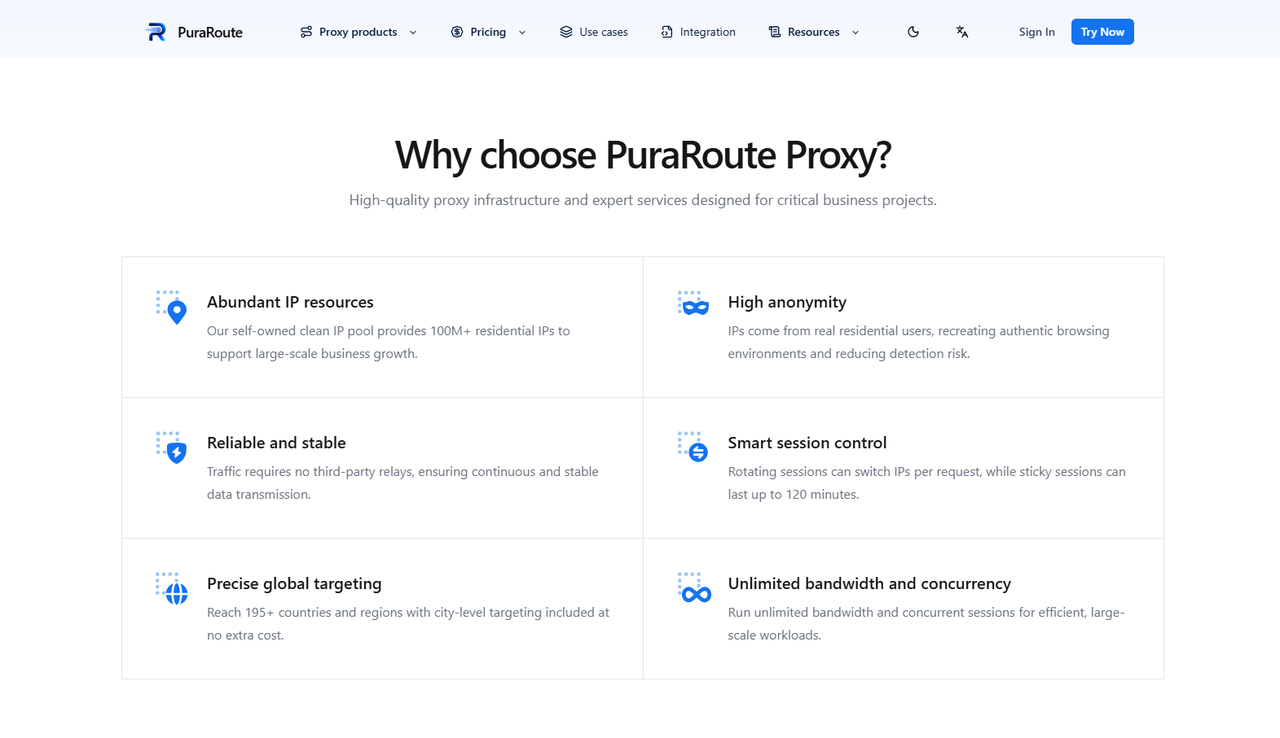
After learning how to choose and set up a dedicated residential proxy, you may want a provider that offers stable IP options without making daily proxy management too complicated. PuraRoute is one option worth considering, especially if you need residential proxies for e-commerce, account management, or market research. You can choose from different residential proxy types based on whether your work requires a fixed IP or flexible IP rotation. This makes it easier to find a plan that matches your tasks and budget.
Exclusive Static Residential IPs for Stable Connections
If you need a consistent IP for daily business tasks, you can consider PuraRoute's static residential proxies. These plans offer exclusive IP addresses that remain assigned to you during the active rental period. You can use the same IP for repeated connections, which may help reduce interruptions caused by frequent IP changes. This can be useful for managing online stores, accessing business dashboards, or running tasks that depend on a fixed network address.
For example, if you manage a US e-commerce store from another country, you could select a dedicated US residential IP and use it for your regular store operations. This may help you maintain a more consistent network setup when returning to the same dashboard. However, connection quality can still depend on your network, the target website, and other factors. A dedicated residential proxy does not guarantee uninterrupted access or prevent account verification checks.
Flexible Proxy Solutions for Different Business Needs
Not every business task needs a fixed IP. If you regularly manage business accounts or run long-term tasks, you may prefer a dedicated residential proxy with a static address. However, if you collect public product data across different markets, rotating residential proxies may be a more practical option. With PuraRoute, you can explore static residential, static native, and dynamic residential proxies according to your needs.
For example, an e-commerce team might use static residential IPs for regular store operations while choosing rotating residential proxies to compare public product prices in several countries. The dynamic residential option supports rotating and sticky sessions, giving you more flexibility over when an IP changes. This means you can choose different connection methods for different tasks instead of using the same proxy type for everything.
Easy Setup, Flexible Pricing, and Multiple Location Options
Getting started with PuraRoute is relatively simple if you already know how to configure a proxy. After creating an account, you can choose a product, select an available location, and purchase the resources you need. You can then copy the connection details from your dashboard and add them to a compatible browser or application. If you are new to proxies, the PuraRoute setup documentation provides instructions to help you configure and test your connection.
Pricing also depends on the type of proxy you choose. Static residential proxy plans are generally billed by IP quantity and rental duration, with options starting from seven days. Dynamic residential proxies are charged by data usage, with a published 100 GB package starting at $1.19 per GB. You can also explore IP locations across different countries, although availability and prices may vary by region. For example, a small business could start with one static residential IP for a week before deciding whether to purchase more. Checking current prices and available IPs in the dashboard can help you avoid unnecessary costs.
If you are looking for a dedicated residential proxy for everyday business tasks, PuraRoute may be worth exploring. You can compare its proxy types, check available locations, and review current pricing. Starting with a small plan can help you see whether the connection quality and IP options meet your needs before making a longer commitment.
Frequently Asked Questions About Dedicated Residential Proxies
Is a Dedicated Residential Proxy Better Than a Shared Proxy?
A dedicated residential proxy gives you exclusive access to an IP address, while a shared proxy allows multiple users to share the same IP. Dedicated proxies may offer more control and consistent performance, making them useful for long-term business tasks. However, shared proxies are often more affordable.
Can I Use a Dedicated Residential Proxy for Multiple Accounts?
Yes, you can use a dedicated residential proxy to manage authorized accounts on social media, e-commerce, and other platforms. Assigning separate IPs and browser profiles to different accounts can help keep your work organized. However, proxies do not guarantee account safety or prevent platform restrictions.
What Is the Difference Between a Dedicated Residential Proxy and a Static Residential Proxy?
A dedicated residential proxy provides exclusive IP access, while a static residential proxy keeps the same IP address over time. Some proxies offer both features, but not all static IPs are dedicated. Check the provider's IP sharing and rotation policies before purchasing.
How Much Does a Dedicated Residential Proxy Cost?
The cost of a dedicated residential proxy depends on the provider, IP location, rental period, and bandwidth limits. Many providers charge per IP for weekly or monthly access. Comparing the total cost and testing a small plan can help you find a suitable option.
Can Websites Detect a Dedicated Residential Proxy?
Yes, websites may detect a dedicated residential proxy through IP reputation, network information, or other signals. Residential IPs come from ISP-linked networks, but they are not invisible to websites. Using a dedicated IP does not guarantee access or prevent security checks.
Conclusion
A dedicated residential proxy offers exclusive IP access, stable connections, and greater control for tasks like account management, e-commerce, and market research. When choosing a provider, consider IP quality, location coverage, and pricing. You can explore PuraRoute's residential proxy options to find a solution that fits your business needs and budget.
