
Open an IP2Location report for the first time and it is easy to feel that this lookup has everything: country, city, coordinates, postal code, network operator, ASN, usage type and proxy type, even a weather station and elevation.
That wealth of information is a strength. For a proxy buyer, however, the task is to identify which fields can answer a delivery dispute, rather than simply read them all. If Anonymous Proxy says No while Proxy Type says DCH, is that a contradiction? If Fraud Score is zero, does the resource suit every account?
My view is that IP2Location is well suited to checking how a database describes a resource, particularly when you need to examine location and network classification together. Its weakness is that the report reads much like a product field catalog, leaving ordinary readers to establish their own priorities. More fields do not mean that each provides independent evidence.
Shareable lookup links are more useful than screenshots alone
IP2Location's online demo lets you look up public addresses and provides a permanent, shareable query link. Reports separate geolocation and proxy information and identify the corresponding source products. When explaining to a supplier or colleague exactly which information you saw, that link is more useful than saying “the website says it is wrong.”
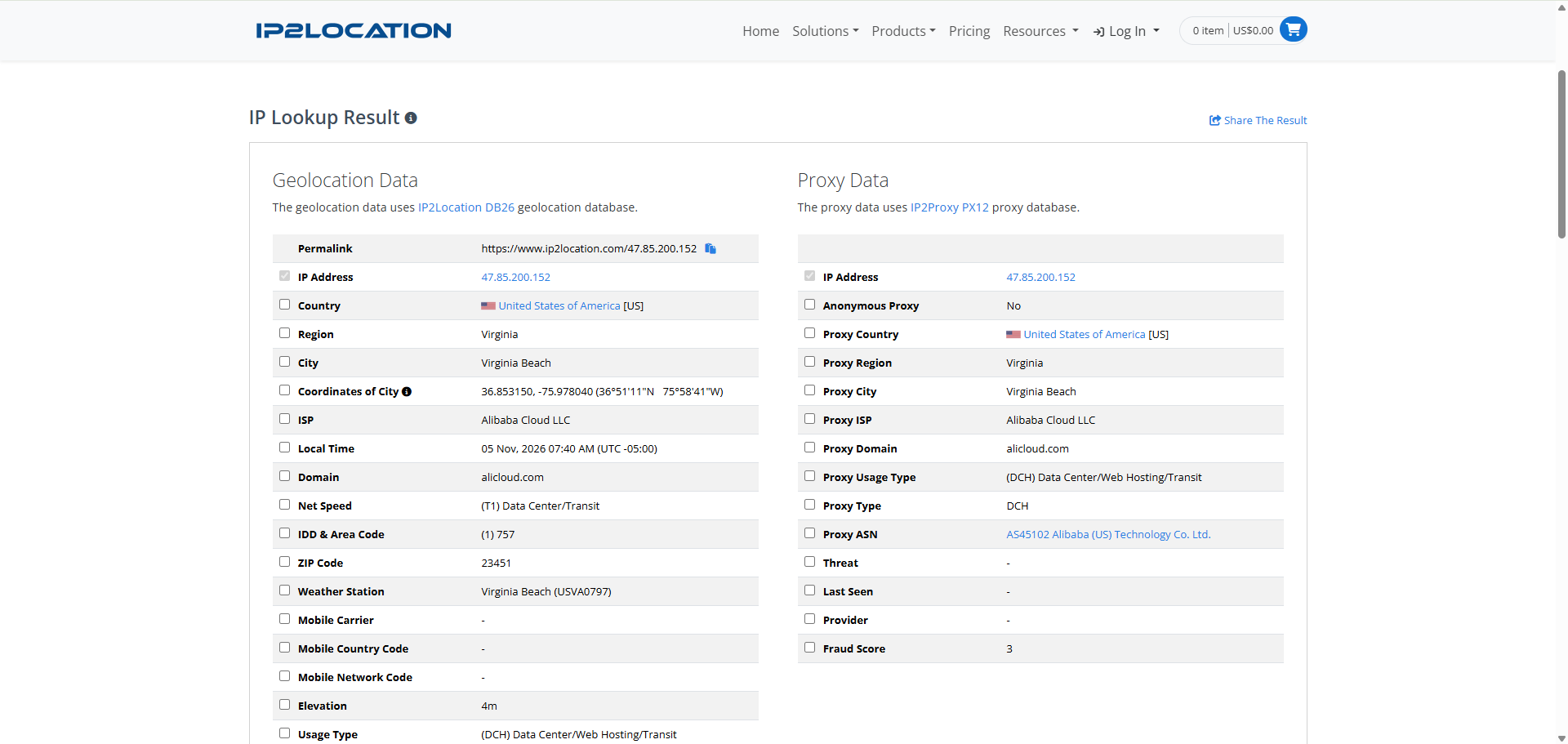
The page explicitly identifies DB26 as the source for the geolocation section and IP2Proxy PX12 for the proxy section. I give it credit for this: at least readers are not led to believe that every field comes from one undifferentiated interface that always returns the same information across products.
The overall experience is closer to reference lookup than step-by-step purchasing guidance. Readers familiar with the fields can quickly find what they need; newcomers can be distracted by long tables. The many API examples and product links also require a distinction between the public demo currently on screen and a service you plan to purchase.
I would start with the address being queried, country, network organization, usage type and proxy classification, then add other fields according to the dispute. Without a specific requirement, there is no need to treat every row as a quality metric requiring investigation.
A Report You Can Check: Why DCH, No and a Zero Score Can Coexist
When I read the public report for 8.8.8.8 on October 22, 2026, the geolocation section listed Google, AS15169 and DCH, with Anycast as the address type. The proxy section simultaneously showed Anonymous Proxy as No, Proxy Type as DCH and Fraud Score as 0. The image below comes from the previous day's public lookup observation and shows the main report sections for the same address.

These results do not invalidate one another. DCH describes categories such as datacenter, hosting or transit networks. Anonymous Proxy is a separate detection result, while Fraud Score is the service's risk information. Network classification, detection of an anonymous proxy and an indication of fraud risk are different questions.
The example also shows that not every field in Proxy Data means “this address is currently acting as a proxy for a particular user.” A section name containing Proxy is no reason to interpret every row as evidence of actual commercial proxy use.
What Can This Public Address Illustrate?
It is useful for explaining the report structure and the relationship between classifications, rather than evaluating residential proxy stability. 8.8.8.8 is a public DNS address, and its Anycast background also means a single city field should not be read as its only service location. This review did not use it to test a supplier, and it certainly does not convert a zero score into a platform success rate.
I recommend trying a named public report to learn how to read the tool. For formal acceptance, you still need to check the exit you actually use. Keep a clear boundary between a demonstration address and a purchased resource.
Rich Geolocation Data Makes Defining Accuracy More Important
Country, region, city, coordinates, postal code, area code and time zone can look like a sequence progressively narrowing down a location. In practice, you should not assume they are seven independent location measurements, all supporting a particular street address.
The report describes the coordinates as city coordinates. Many decimal places indicate a detailed display format, rather than a device located to the same precision. The weather station, elevation and additional regional information should not be treated as actual device sensor data either.
If the purchase requires only a particular country, a different city point may not affect the task. If it requires a specific city, define separately how database recognition and physical location will be checked. Do not wait until after payment to discover that the two parties understand “an IP in a particular place” differently.
Three Location Requirements Need Separate Discussion
You need a particular database’s location
Choose the data source first, then retain the report, date and product version. IP2Location suits this check because its result and lookup link can be saved directly.
You need the exit device’s physical location
A map is insufficient. Add relevant network measurements, facility information or other evidence. A database placing an IP in a country does not directly establish that the device is there.
You need the destination website’s location decision
Check it in the actual authorized task. The destination may use another database or its own rules. A proxy provider cannot guarantee that every website will always display the same location.
These three requirements may overlap, or they may differ. IP2Location most directly helps with the first and provides background for investigating the others. If a review fails to distinguish the requirements first, additional fields merely add confusion.
A Research Reminder: Database Location Does Not Always Establish Physical Location
In “How to Catch when Proxies Lie,” presented at IMC 2018, Weinberg and colleagues combined latency measurements, AS information and network data to study 2,269 proxy server addresses from seven services. A central issue in the paper is that databases may agree with an advertised location without providing sufficient proof of a server's actual location.
This research uses an older sample. It is neither a validation of today's IP2Location DB26 accuracy nor a test of PuraRoute. I therefore do not use its proportions to rank the current proxy market. What informs this review is the evidence method: verifying physical location requires material independent of advertising and database entries.
If the task requires only a database location, the report is already useful. If it requires an actual local network perspective, add the appropriate verification. The distinction is between what is being accepted, rather than which requirement is superior. Choosing the right evidence helps establish whether a map is sufficient to support the decision.
Network Background: Start with the Relationship Between ASN and Usage Type
ISP describes the network organization, ASN is the autonomous system number, and the associated prefix describes the routing range containing the address. These help establish what kind of network supplies the resource, but do not directly observe what the end user does with it.
IP2Location lists both Usage Type and AS Usage Type, making it useful for examining the relationship between address-level information and the network's overall classification. Matching values should not automatically be read as two independent residential certifications. If they differ, first examine the subject and definition of each.
Why Is DCH Not Shorthand for “Confirmed Fraud”?
Datacenter and hosting networks support large amounts of legitimate activity. DCH helps assess whether a resource's background matches the order, but a network type cannot directly become proof of malicious behavior. Conversely, a non-DCH classification does not automatically guarantee an absence of proxy use or historical issues.
If the order explicitly requires a particular kind of residential resource while results persistently indicate a different background, a review can be requested. That requires examining the product definition, the scope of the information and other evidence. A single abbreviation is usually insufficient to declare that a supplier has misrepresented the product.
I find this section useful for purchasing, provided “does it match the agreed type?” and “is there risky activity?” remain separate conclusions. Otherwise, readers may wrongly assume all datacenter resources are poor and all residential resources inherently reliable.
Net Speed, Local Time and Last Seen: Names Need Context
Three names in the long report deserve a pause:
- Net Speed: a network classification, not a measured download speed through your proxy.
- Local Time: the time in the listed location, not when the database last updated.
- Last Seen: a time associated with activity in the proxy data, which needs to be read alongside what was recorded.
Clear explanations matter more than extra fields here. Otherwise, more complete data can create more mistaken expectations.
Consequently, T1 cannot be converted into your task's throughput, and a current local time does not establish that the data was just refreshed. An empty Last Seen field likewise should not be filled in mentally as “never seen”; scope and coverage still matter.
These cautions do not make the fields valueless. Classification helps explain the background, local time assists cross-region reading, and relevant activity times help assess how current a record is. The problem is allowing names to imply conclusions the data does not supply.
| Field or observation | What I would use it to assess | What I would not claim from it |
|---|---|---|
| Country, city and coordinates | The location description supplied by the database | The device or street has been located |
| ASN, ISP and usage type | The relationship between network background and the order requirements | The actual user's activity has been confirmed |
| Net Speed classification | The network category under the product definition | Current proxy speed has been measured |
| Anonymous Proxy / Proxy Type | The corresponding classification and detection results | Every form of anonymity has been ruled out |
| Fraud Score | Risk indicators from this service | A probability of passing or being blocked by another platform |
The Proxy Section: Read the Category Before the Risk
The IP2Proxy PX12 product description lists information on proxy type, usage, timing, threats, providers and fraud. For people incorporating type detection into resource records, this offers more room for explanation than a Boolean value alone.
Category and risk still need to be kept separate. A residential proxy detection result may indicate that the system identified that use; it does not mean all such traffic is fraudulent. A negative detection may also reflect coverage. Type provides a description, while risk information raises further questions. Neither should substitute for the other.
Handling Empty Fields Determines Whether Batch Checks Are Reliable
When reading a webpage manually, people often skip over a dash. Once integrated into a system, automatically converting blanks to false or zero can create a set of false passes. A more reasonable approach is to preserve unknown values and decide whether further checking is necessary for the task.
I would save the field's original meaning and product scope, rather than only the final pass or fail. That makes it possible to investigate a later change: did the address change, did the product gain a capability, or was the relevant information never available before? The rich set of fields is worth using, but incorrect simplification should not cancel that advantage.
The Online Demo, Databases and API Offer Different Commitments
I think many IP2Location reviews underexplain this distinction. The public demo showing DB26 and PX12 does not mean every free account, database package or API plan returns the same content.
IP2Location.io's current pricing page divides geolocation and proxy capabilities into tiers. For proxy detection, the free and entry tiers mainly list PUB. Higher tiers add capabilities such as VPN, Tor and residential proxy detection, while the Security tier further includes DCH and fraud information. Quotas and prices may change, so purchasing should be based on the current table and the fields you need.
The first step in selecting a service is to specify those needs. Looking up only countries and basic network background may not require the entire security field set. If you need batch residential proxy detection, however, seeing it in the demo does not establish that a lower-tier API includes it.
API Examples Explain the Structure, Not Your Account Entitlements
The JSON example makes the move from webpage to API easier by showing the response structure. Before integration, check the API against the selected plan: did the request succeed, did the required data arrive, and how are missing items handled? A field in an example does not establish access for your account.
I would first use a small set of queries to confirm that the fields are available, their definitions are clear and the quota suits the task, before considering batch use. That grounds a paid decision in actual requirements, rather than buying the highest tier because a long report looks comprehensive. The public lookup is already useful for individuals; scale introduces a different set of costs.
Checking a Proxy's Region: Define “Correct Location” More Precisely
First establish whether acceptance concerns the country, state or province, city, or recognition by a particular data source. Then confirm the actual exit, rather than merely copying a gateway or the address displayed in an order. For rotating resources, retain the exit associated with each session, so two different addresses do not become a discussion about one result.
If you use PuraRoute, its static resource purchasing and viewing instructions can help you check the selected country, inventory, and the delivered resource's Location and Exit IP. You can then use IP2Location to examine information about the actual exit. Bringing the purchasing requirement, account records and external recognition together makes a disagreement easier to explain.
This is more reasonable than buying a batch and then requiring ten websites to agree on everything. If a specific city is needed, confirm what can be supplied before purchasing. The ability to select a country does not imply that every city is always in stock. This review also offers no tested guarantee of brand coverage or database agreement rates.
Respond According to the Type of Disagreement
If the country persistently differs, prioritize the actual exit, connection setup and delivery. If the country is correct but the city differs, investigate database recognition and the task's tolerance. If only one source disagrees, save the evidence and continue checking rather than immediately rejecting the resource.
If information genuinely needs correction, find the relevant data source and correction channel. Updating a record on an aggregation site does not mean every platform will synchronize, and not every problem in a business service should be attributed to geolocation fields.
A Reproducible Record Matters More Than Saving Every Field
I would retain the address, lookup date, report link, actual use case, product being consulted and key fields. List only the differences relevant to acceptance, then explain whether they affect the task. Colleagues can then check the evidence, and the supplier knows exactly what is being questioned.
For example, a country-level recognition requirement does not call for an argument over elevation or weather stations. A fixed network background requirement calls for continued observation of the corresponding information and resource allocation. A field appearing in the report does not mean it belongs in the acceptance contract.
Tracking change also requires a consistent basis of comparison. Do not directly compare a public demo result with an API response under different permissions and call it fluctuating quality. Establish the sources and fields first, then discuss whether the resource changed.
What Research Is Worth Citing When Assessing Geolocation Accuracy?
One address that matches your own location is insufficient to establish accuracy, just as one large discrepancy cannot establish that a tool is poor overall. A test needs an independent location reference, a clear sample source, and separate treatment of country, region and city-level granularity.
Fixed networks, mobile networks, proxy exits and Anycast also involve different conditions. Results from a sample dominated by fixed broadband cannot be applied unconditionally to rotating residential proxies. A study using an older database or another product tier cannot directly rank the current demo either. Reviewers have a responsibility to explain these conditions, rather than extract an attractive percentage alone.
I prefer research that reports error ranges, missing information and sample limitations. Country-level matches and city-level distance errors answer different questions; a vague claim of “high accuracy” cannot summarize both. For actual buyers, knowing when a tool may be wrong is often more useful than seeing a single number.
This review does not have such an independent sample, so the assessment focuses on report usability, field interpretation and acceptance methods. That scope still supports a clear judgment: the organization of the information is valuable, but the apparent precision of a map cannot replace verification.
Turning a Report into a Specific, Concise Written Assessment
The following illustrates a way of writing the record, rather than a commercial proxy test conducted for this review. Suppose the order requires a fixed exit in a particular country and you have confirmed the actual address from the current browser. The assessment can be divided into three paragraphs.
The first covers delivery and observation: “What did the order require, what exit is currently in use, and which key information was read from which report on which date?” The second covers differences: “Does the country match, which city or network classifications still disagree, and are the information sources consistent?” The third covers action: “Is the task affected, what evidence is still needed, and should the resource be retained provisionally or submitted for review?”
This is easier to discuss than “it failed IP2Location,” and does not impose obligations on the supplier that the tool never promised. If only the city differs while the task requires a country, the assessment can explain that the current difference does not affect acceptance. If the country persistently differs, leave the issue for connection and delivery verification.
Interpret Rotating Resource Samples Alongside the Rotation Strategy
If the product is designed to rotate, one lookup describes only that exit. To understand allocation behavior, record each actual address and its time, distinguishing repeated assignment of the same address from a genuinely new sample. Ten refreshes cannot simply be called ten independent resources.
The sample should cover the periods and regions relevant to the task, rather than retaining only lookups that match expectations. When an anomaly appears, first examine reproducibility and the allocation context. When everything looks normal, that still only describes the scope observed. This approach both protects buyers from attractive but misleading screenshots and avoids judging an entire resource pool from one isolated result.
I find IP2Location's permanent query links particularly useful for this recordkeeping. They cannot design an experiment for you, but they make address information easier for others to check, which is more valuable than an untraceable one-line conclusion.
The Usability Tradeoff: Professional Detail, with Priorities Left to the Reader
IP2Location's strengths are centralized reports, detailed categories, explicit source products and query links that support communication. For readers willing to study field definitions, it makes location and network background questions more concrete.
Its weaknesses are the many English abbreviations and additional information that can create an exaggerated sense of precision. The relationships between the demo, products and API also require active attention. It does not arrange purchasing objectives for proxy buyers, so first-time use involves a learning curve.
If you need to know quickly whether the current browser uses the proxy, Whoer or a simple exit page takes less effort. For connection leaks, use IPLeak or BrowserLeaks. For a detailed check of geographic and network fields, IP2Location has more to offer.
I would include it in location and type verification, particularly when delivery information disagrees. Its value lies in understanding which data supports which judgment and which questions still need other evidence, rather than describing an IP in ever greater detail.
FAQ about IP2Location
Is Anonymous Proxy: No inconsistent with Proxy Type: DCH?
Not necessarily. They describe different classifications and detection results. A datacenter background does not mean an anonymous proxy or fraud has been detected.
Does a Fraud Score of zero make the address suitable for every overseas platform?
There is no such guarantee. It is risk information from this service, rather than a statement about other platforms' rules, account conditions or actual task outcomes.
Do coordinates with many decimal places mean precise geolocation?
No. Display precision differs from actual geolocation accuracy. Check the field definition, scope and the subject of the data.
Is T1 in Net Speed an actual download speed?
It is not a speed test performed from the current device through the proxy, and cannot be converted directly into real task throughput.
Does the free API include every field in the public demo?
That cannot be assumed. The demo, database packages and API plans have different coverage. Check access against the specific product.
Can agreement on a city across multiple databases prove a proxy's physical location?
It is still insufficient. Databases may use related information; physical location requires appropriate independent measurements or other evidence.
Should I immediately replace a proxy with the correct country but a different city?
First examine the order requirements and actual task. A city discrepancy should not automatically invalidate a country-level requirement. An explicit city requirement calls for further verification.
